

The Cognitive Cartoonist
Joyce Gao uses comic panels as two-way windows between lab data and lived feelings, not just things to gawk and marvel at.

TDSD will be hosting an exhibit of researcher-creatives like Joyce in mid-November. Our official announcement drops tomorrow (November 7th). If you’d like to support as a patron or sponsor, please get in touch!
Joyce’s comics are responsive, calibrated, and honest about noise — just like the instrumentation you’d see in a neuroscience lab. Her panels sit where research meets real life, where a result line intersects a sleepless night, where “objective” findings collide with subjective experiences.
In her latest work, Connecting Through Closed Doors, she resists the easy explainer and invites us into the room: blue hour light, unanswered knocks, the stubborn complexity of mental health. We explore her palette of constraint, her rule to keep evidence solid but human stakes visible, and a philosophy of storytelling that refuses to fight between accuracy and feeling.
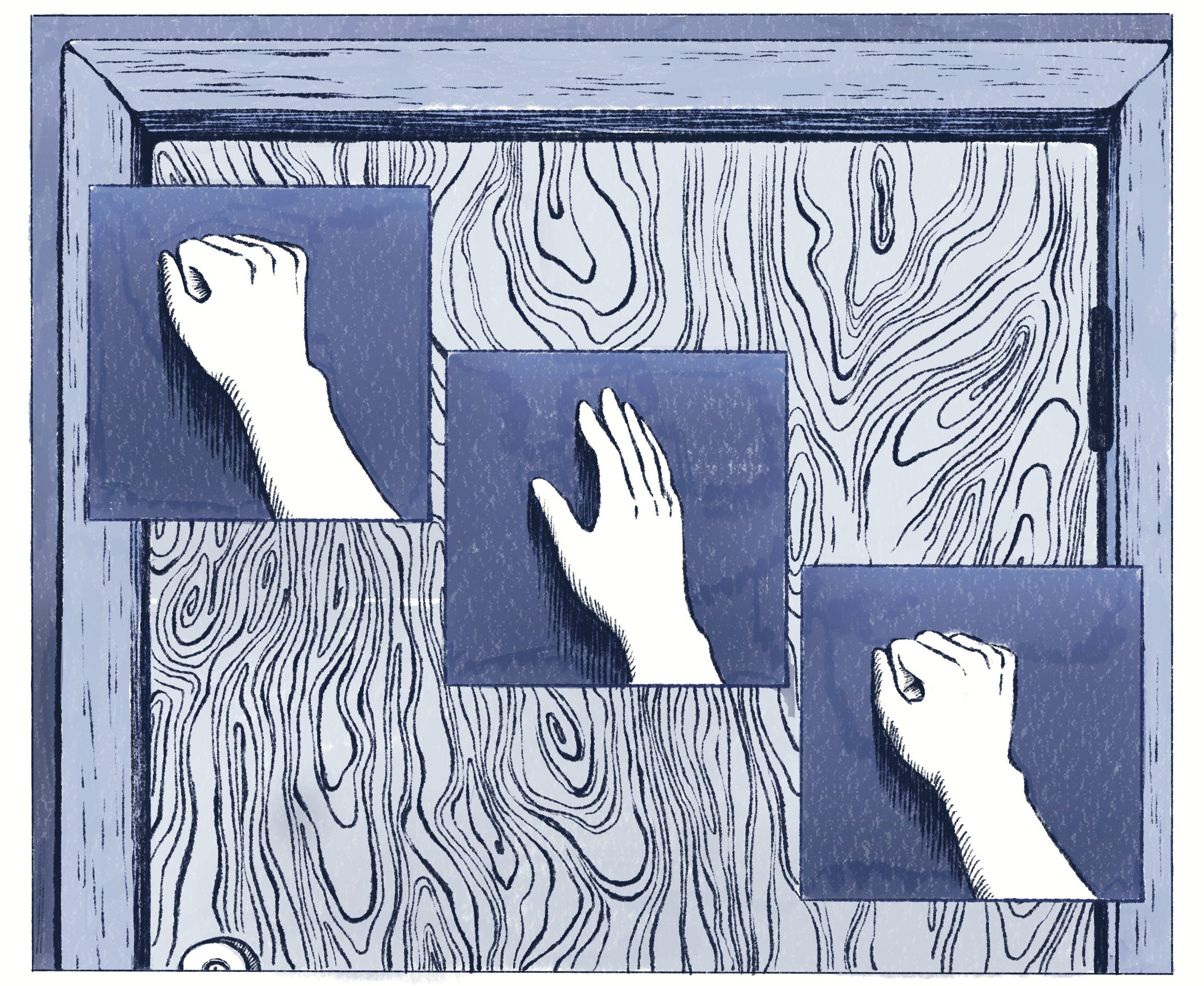
You’ve mentioned that art can be used to bring clarity to scientific concepts but also humanize and complicate science. What do you mean by that, and when does art become a bug and not a feature?
A lot of science communication that I’ve been in touch with, especially in the world of comics, has been art in service of science.
For example, there are these artist residencies in science labs, but you don’t really see that kind of relationship in reverse. So I’ve been trying to think about how we can spin this around, about what art can bring to science rather than just giving it a pretty packaging that doesn’t touch on the core of the work.
What art does really well is that it humanizes scientific stories and celebrates ambiguity. In scientific storytelling, we’re trying to do something that’s very linear and clear, and often we take out everything that is not directly related to the story. But art lives in the grey area, often it simultaneously rejects and celebrates, is sincere and sarcastic, and that is the kind of complexity that I am often drawn to. I think that is especially important when we are looking at subjects as complex as mental illness.
For instance, in my type of comic, I’m trying to bring in a more subjective and personal view along with the scientific story. That’s the kind of storytelling that I don’t really see in science, and it’s something I really want to try to bring together.
Why comics?
I grew up doing art: it was the one thing that I really relied on throughout high school and also college. I’m naturally inclined to process things visually, scientific or otherwise, so comics just made a lot of sense. I also write a lot and enjoy different kinds of narratives, so comics is the perfect medium to bring together that visual and narrative aspect.
And I think a lot of it was also inspired by Matteo Farinella, who is a science communicator and comics artist at Columbia. He’s the one that told me: “if you want to do science-related art, you should start doing it now.” He was also an editor for my mental health comic, which was a very nice full circle moment.
Walk me through your ideation process – what tends to come first for you: the concept, imagery, color palette, or something else?
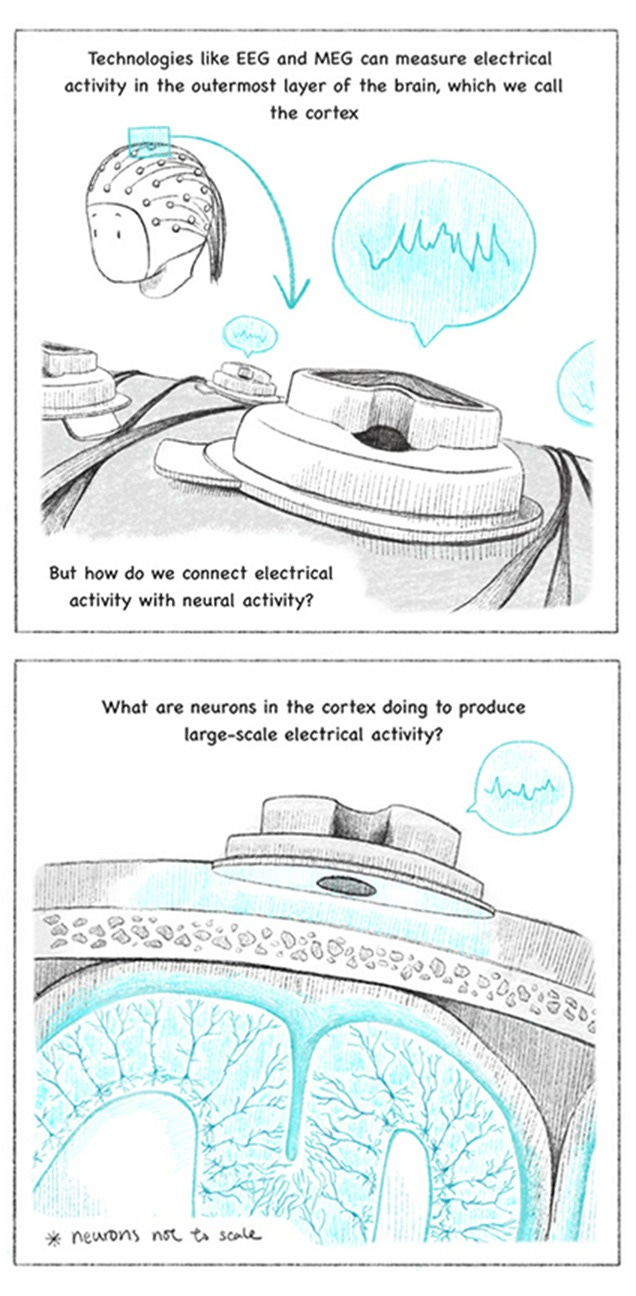
I don’t think I have a unified pipeline yet because I’ve only released two science comics, and they’re both very different processes. For the Human Neocortical Neurosolver (HNN) comic, that one had a very clear goal – explain HNN in an approachable way to people who maybe don’t know much about neuroscience. This is very much an ‘art in service of science’ kind of project, where I’m just trying to package it in an approachable way.
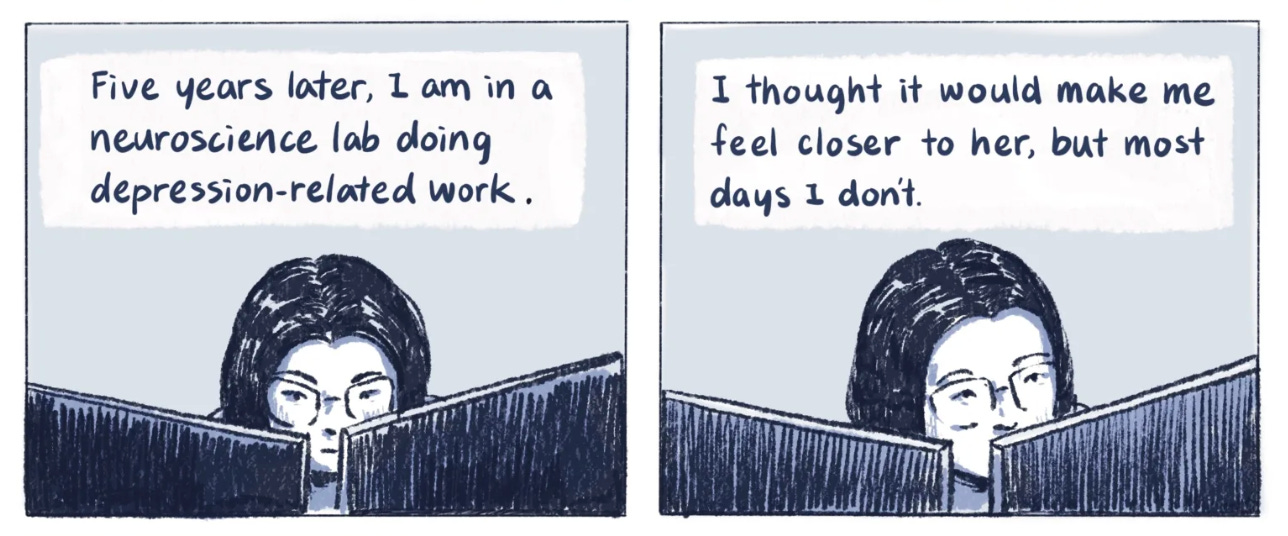
The depression comic is a lot more complicated because I wanted to make it somewhat of a touching story. I wanted to decentralize science a bit in the story. That one started off with being frustrated at work, that feeling of, everything is complicated, I feel like I don’t understand anything and this research is not really going anywhere. What progress [in mental health and psychiatry] have we even made in all of these years? There were moments when I was just staring at my screen, sitting at my desk, feeling that doom and gloom.
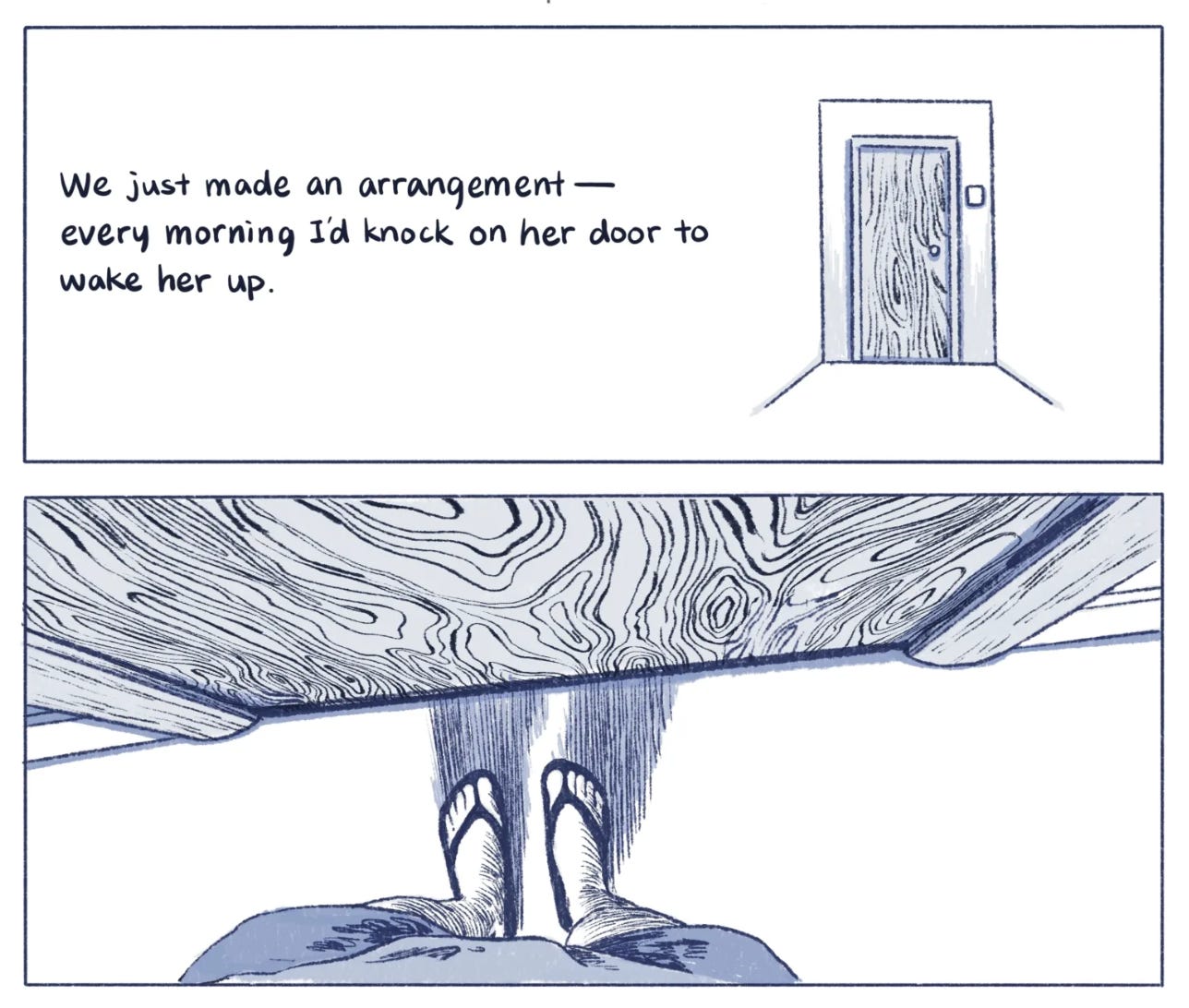
And that immediately transported me back to that very familiar feeling of trying to knock on my friend’s door [as shown in the comic] and not getting a response at all. Those two emotions overlapped really well and that was the seed of everything.
I thought, okay, this is a very interesting and intense feeling that I wanted to express in some way – what is the message in this feeling and how can I build a narrative around it? Then came other questions like, why do I want this feeling to make sense to other people? Why does this story even matter at all? What kind of background do I need to reach non-neuroscience audiences? How do I tell this story so it’s not all doom and gloom?
When you’re thinking about certain ideas and themes, how do you decide what to abstract? What guides your choice to leave it to the viewer, as opposed to breaking something down in detail?
I show it to as many people as possible. I’m generally good at predicting what people are going to understand, but there are also moments where I’m not the most accurate.
By showing things to friends and family, then asking them: “what did you get out of this?” I got a lot of feedback on what was clear, where it was unclear, what it seemed like I was trying to say. For that comic specifically, I think this process pushed me to find somewhat of a fitting ending.
Are there points during the creative process where you’re sketching, coloring, or designing and the scientist part of your brain comes in and interjects?
The most common part where my scientist brain comes in is wanting to add more information and examples. For the depression comic, I wanted to illustrate how slow neuropsychiatric drug development has been in the past few decades.I had all of these different examples and I wanted to explain how testing animal models doesn’t exactly translate to humans, but my editors were like, okay, we gotta cut some of these because then you’ll need to explain what an animal model is.
That’s the scientist part of me wanting to fit in as much evidence as possible, to back up everything with facts.
But when you’re trying to make a story that also tries to appeal to emotions, sometimes the factual part, while it should still be solid, doesn’t need to be as center stage. And that’s usually a part where my brain struggles a little.
The subtitle of your comic was also something that stood out to me: ‘learning to embrace the beauty, complexity, humanity of mental health research.’ That sets a pretty clear tone. And even the title itself is about connecting through closed doors.
What closed doors are you most intent on opening for the reader?
I think this comes back to the idea of the scientist brain and artist brain fighting a little bit. The scientist part of me wants to open the door for neuropsychiatric diseases and find cures.
The artist part of me wants to humanize the process of that scientific discovery.
Many people who have experienced mental health issues speak about a disconnect between the biomedical treatment of mental illness versus the actual human experience of mental illness. Neuroscience research of mental health is often seen as quite clinical and cold, and focuses heavily on medication rather than holistic care. I want to offer an alternative to that narrative and impression that people have on mental health research.
So one of the things I wanted to show in this comic was a very human researcher feeling overwhelmed in this entire landscape, and facing up to the complexity because they are motivated by something deeply human. I think that gives some emotion to the clinical distance that is necessary in research.
We’ve had decades of misinformation and miscommunication in neuropsychiatry. Are you optimistic that there are going to be more science communicators changing that, or do you think it’s one of those things where there will always be a divide?
I am cautiously optimistic. I think there are a lot of really cool and inspiring scientists in my generation who are also very driven science communicators. For me, I think the path forward is first to own up to all of the progress and mistakes we’ve made as a field—psychiatry and mental health research in general. I think psychiatry is still quite mysterious to a lot of people, and that transparency in what we don’t know will build a good foundation for moving forward.
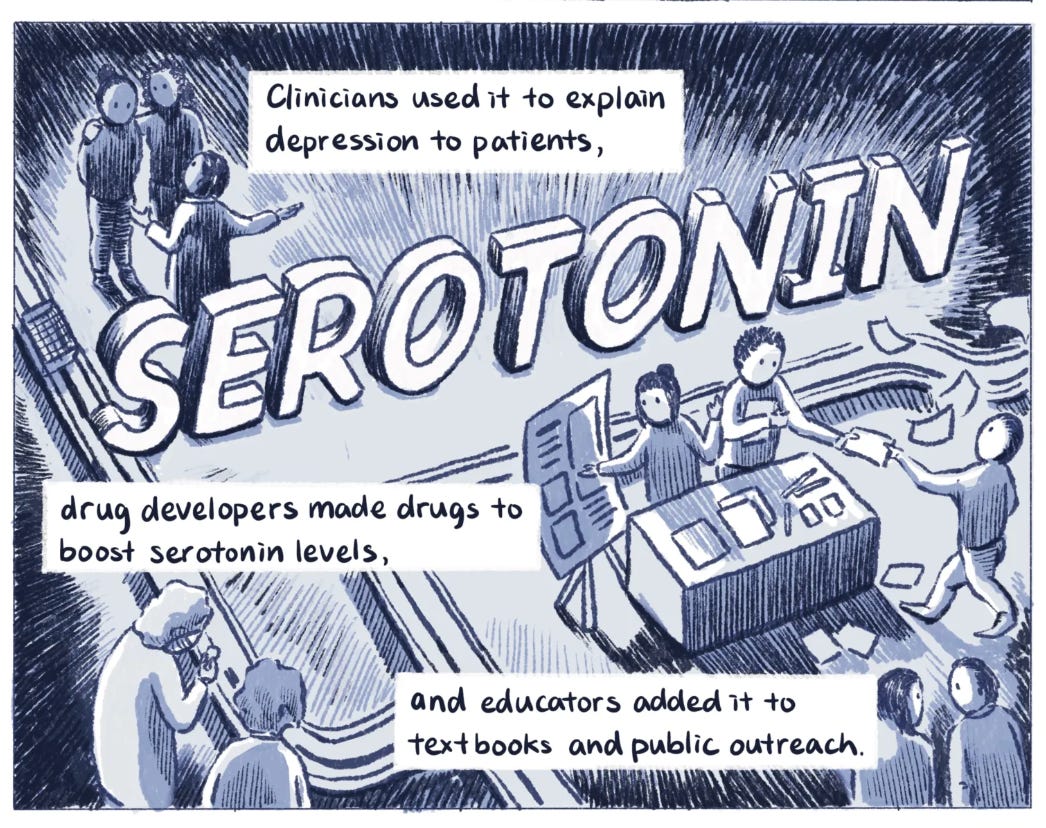
Going back to the comic then, one of the things that I found really interesting as a stylistic choice was the self-insert. When it comes to topics like mental health, a lot of authors and artists tend to abstract themselves away from the topic, because distance creates comfort.
Why did you think it was best to present this from a first-person perspective? Why was it important for you to be the narrator?
I wanted to talk about the frustration with the field and my work, while making sure I could put a huge asterisk behind everything I say – that this is my opinion only.
I wanted to make sure I am not saying that this field is going nowhere, or that neuroscience is pointless. This is just me, as a very young researcher, being confused about the vastness and the complexity of this field.
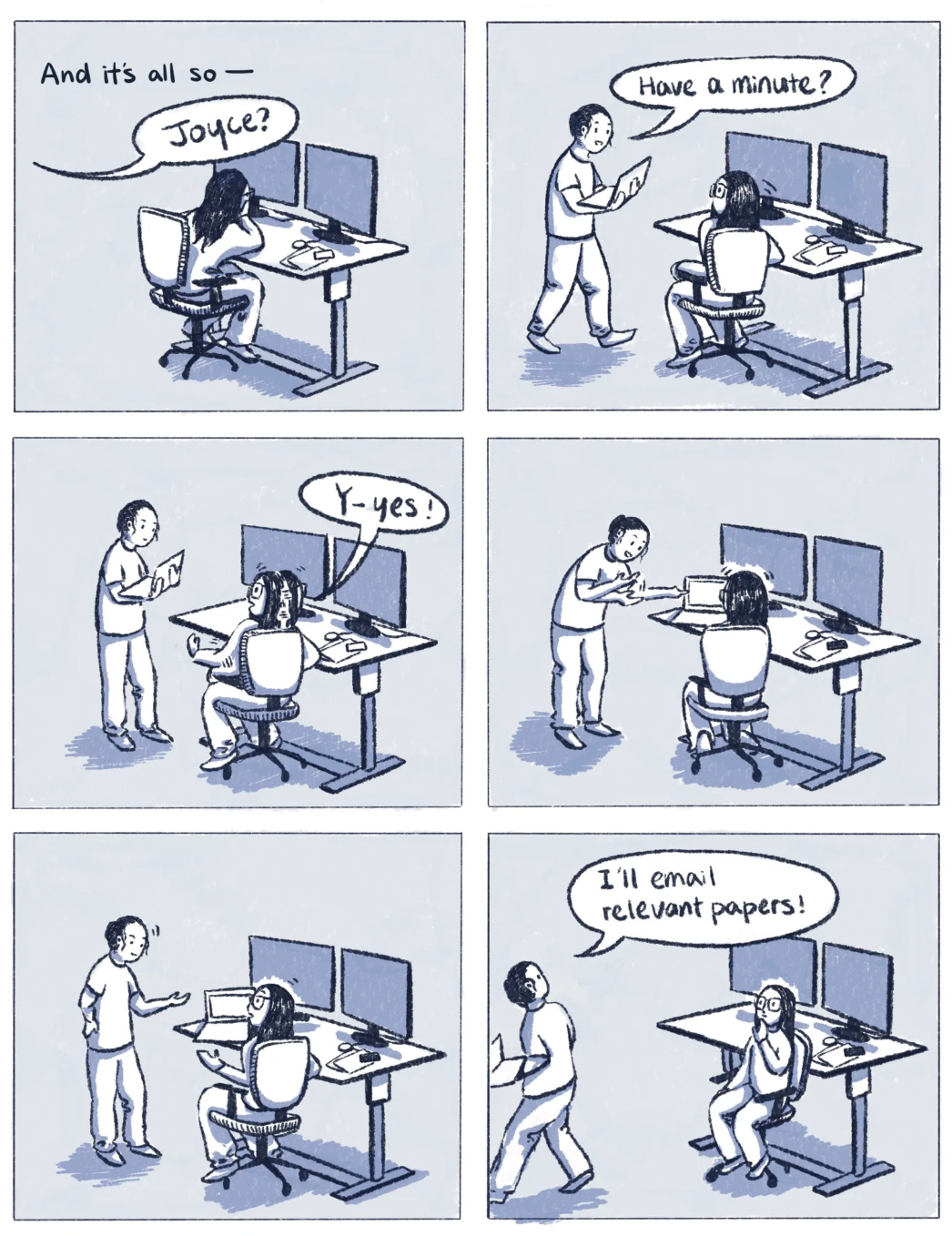
Were there any artistic guidelines that you gave for yourself when you were prototyping?
The color is very deliberate. I went for a limited palette of blue and yellow – it ties back to my obsession with lights through windows during the “blue hour”, but that’s a different thing.
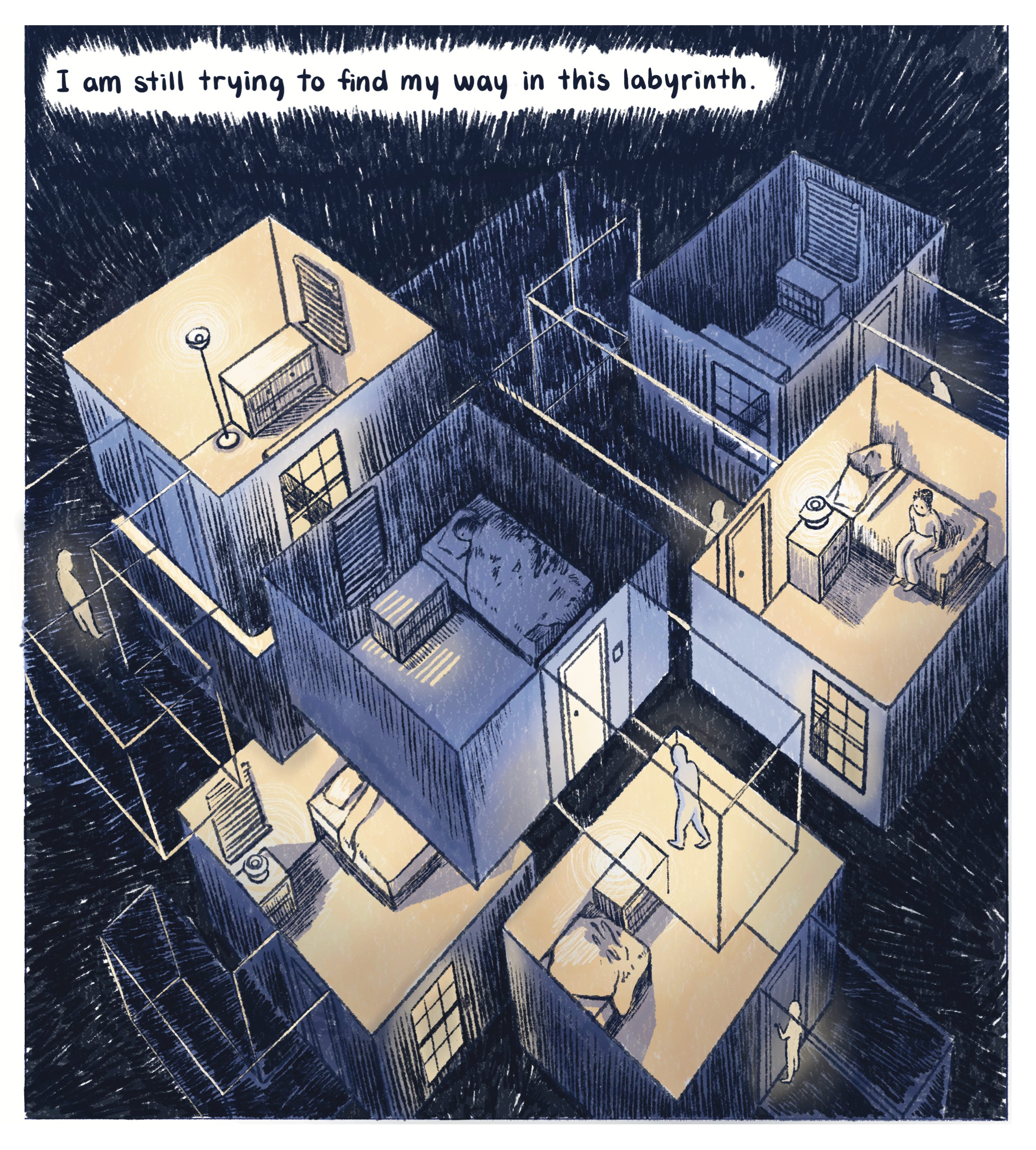
The goal here is to give myself constraints so there’s more creativity. One promise I made to myself (that I didn’t follow through with!) was to try a style that’s less time consuming. I really admire works where they’re not the most technically sophisticated, but they convey so much with such minimalism, and that’s always something that I wanted to achieve. Maybe that’ll be the goal for the next project!
Which part of the story was most difficult or challenging, stylistically?
The ending was really hard. I think it took me a long time to figure out what I wanted to say with this, especially because the source of this comic comes from a very negative place. I was trying to spin this in a way that was cautiously hopeful, but also true to how I felt.
I ended up landing on a human connection theme that I truly believe in, which also gives optimism to the future of the field.
How do you think science communication can both balance the technicality and accuracy of science, but still be captivating in a way where people want to keep reading and immersing themselves? How can you or others balance that accuracy as well as the visual aesthetics of that?
That’s a really good question. I think it comes back to a lot of the ‘art in service of science’ category, where often you create a character that explains stuff to the readers, the viewers. If you’re doing neuroscience, you make a cartoon neuron that’s explaining stuff to you [like they do in textbooks for school]. And maybe if you’re lucky, they’ll give the neuron some kind of personality that makes it interesting. But usually, you’re not very invested in this character that’s guiding you through a scientific journey.
If the goal of the piece is completely educational, then it might make sense to just put some kind of character there to explain things. But if you can afford some wiggle room to help viewers feel invested in your characters, I think that emotional connection can be really captivating.
One of the biggest bottlenecks I see in science communication is moving beyond the general public – to attract other scientists and professionals, just beyond your immediate field. I’m speaking broadly here, but it’s challenging to provide enough detail where it still makes technical sense, but doesn’t feel like something you read in passing. How do we get science communication to maintain that same rigor without losing heart and soul?
This reminded me of a complaint that I hear a lot from many scientists – you publish a scientific article on a very specific topic, then your university’s communication office takes it, spins it into something that makes it seem more impressive, and then this random news source takes the university headline, and it just spins out of control.
Researchers should be more engaged in the communication process because the most accurate kind of communication is going to come from the person who actually did the science.
And how do we engage them?
I feel like this is a course that should be taught at the graduate level. The most ideal situation is having researchers who has both the communicator and researcher mindset. But that’s not something we can force to happen. Realistically, it makes more sense to encourage PIs to want to have PhD students or postdocs in their lab who have backgrounds in science communication, to work alongside them and support their production of science communication materials.
I wanted to end on like a more positive, fun note. What is a trope in scientific illustration that you wish we would retire?
Okay, this comes back to the ‘cartoon character leading you through this process’ trope. It’s such a juvenile way to teach people things.I remember sitting in science classrooms as a kid and watching those DVDs, and just thinking, this is so childish. I don’t care about this.
It’s not the cartoonizing that is the problem, it’s how didactic and boring the characters are. It’s kind of like a half-hearted effort to make the content fun, but ends up being condescending and infantilizing.
On the flip side, what do you think is a style or an element you wish we did more of?
I think humor is so important, and it helps you learn really well. I’m thinking about Hank Green, 3Blue1Brown. Their videos make so much sense, it’s so funny, and they communicate ideas really well. I want to see that more. Humor makes you remember things.
Our last guest left this question for you: if you could make everyone experience something, anything in the world, once, what would it be?
Oh, there’s so many answers! [laughs] I want people who don’t “create” to experience the struggle of creating something.
When I told my dad I was making this comic about mental health research and publishing it, his response was: “It must be really nice to get paid for doing something that you really love.” Great!
But then he followed up with, “I wish I could get paid watching NBA games.”
I love my dad with my whole heart, but it’s very clear that he has never done any kind of creative work in his life. I want people to understand that creating a piece of work that makes sense, and something that stands for itself, is so much work. At the end of the day, it’s very rewarding, but the process of it is more grueling than people usually imagine.
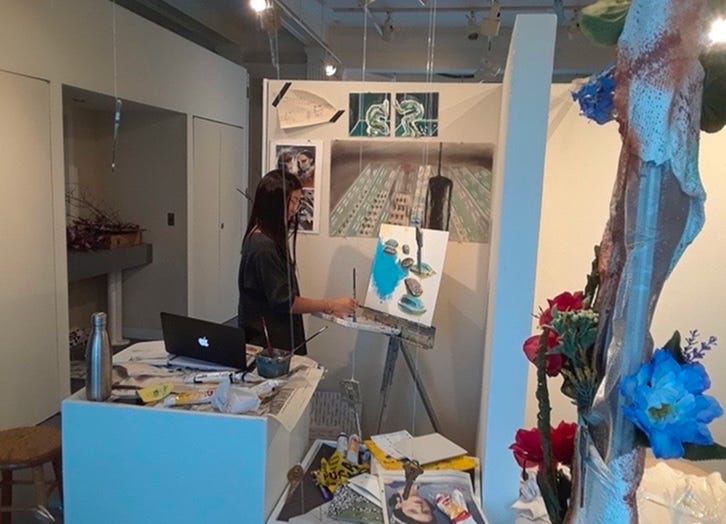
A labour of love. What’s a question you’d like to leave for the next guest?
Oh, one thing I’ve always wanted to hear about, especially from creative technologists, is their understanding of the relationship between art, design and science. These are the three fields that I move between quite a bit.
I’m always trying to define what part of [my work] is art, what part is design, and what part is science. Especially for creative technologists, they live in between the three fields, so I really want to hear what their thoughts are on how these three fields come together and the differences.
That’s Joyce, everyone.
Thank you so much.
Thank you, Joyce!