


Welcome to the Dossier — a series of oral histories highlighting research through transcripts, images, and artifacts.
TDSD will be hosting an exhibit of researcher-creatives like Ninon in mid-November. If you’d like to support as a patron or sponsor, please get in touch!
A neuroscientist by training and a performer at heart, Ninon translates dreams and brainwaves into couture: masks that glow based on the emotion of the wearer, bodysuits that conduct light like thought. What happens when signals become something you can wear? We trace her path from theatre to programming, from her first line art to fiber optics, and, of course, about philosophy, art, and science.
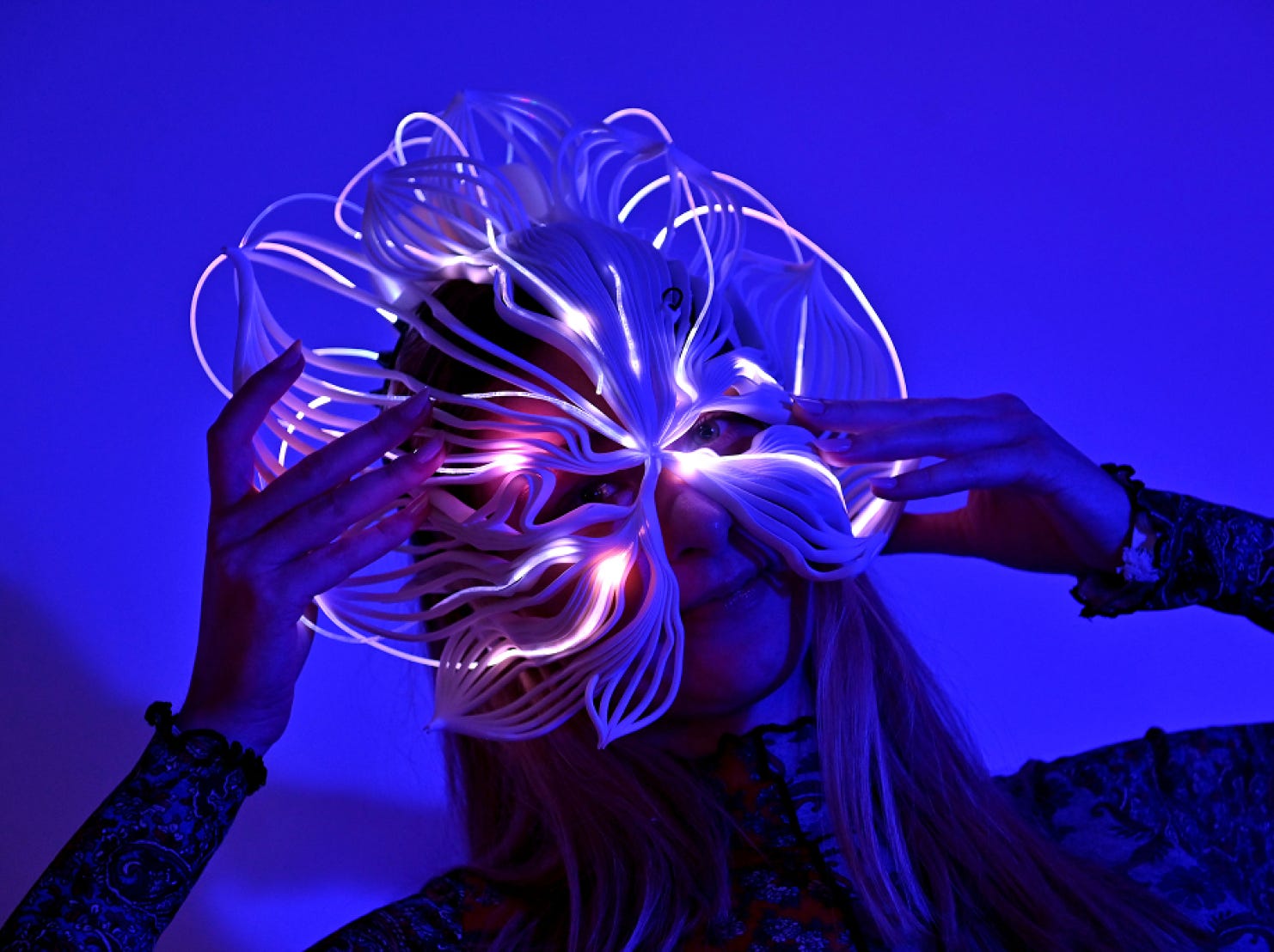
I’ll never forget the first memory I have of meeting you in Boston – one morning you walked out of your room with EEG sensors on your head.
Yes, I had two EEGs in my bedroom.
And since then, you’ve come so far.
A lot of people will talk about the technical side of you, but I think less people know that you actually trained in theater, in music and fine arts.1 You did a lot of work in philosophy before neuroscience even came into the picture for you. What, in that early artistic training or humanities training, made you want to bring science into the picture rather than keep them separate?
I would retrace this to high school, actually. Until the second year of high school, I was in science. I was on the path to becoming a pure scientist because, in France, art and science are very compartmentalized.
You can’t do both.
In the middle of high school I decided to quit science to join fine art and literature studies - this was my first move to art.
That meant I had six hours of fine art practice per week and nine hours of philosophy. I was really passionate about this! After that, I had a philosophy teacher encourage me to pursue an engineering degree, so I ended up in a dual degree where I studied both humanities and computer engineering.
The first language I had to learn at university was Pascal. It was awful! [laughs] And I remember ditching my required Pascal classes to sneak into advanced philosophy lectures as an auditor.
I really, really dislike Pascal very much.
At 16, in high school, I’d already written my first computational art program in Python, generating infinite lines in endless shades of blue using Tkinter.


So I think I’ve always been in between art and science.
I try to maintain rigour in science and also be accomplished in art. It’s always been important to find that balance. During my engineering degree, I was exhibiting an art installation in Paris while trying to catch up [on maths classes] because I didn’t study math in the last year of high school. So I had to put in a lot of effort to match the level of the engineering school.
I was first person from a fine art background that this program accepted. Normally they require a maths speciality from high school - I didn’t. My specialty was fine art.
You mentioned your philosophy teacher was quite important in shaping your path. What was it that he said that was powerful enough to get you to pursue engineering?
When I was in my art specialty, I could really feel that there was still a dimension lacking.
In science, I was the artist of the class, but in art, I was the scientist of the class. I was a very nerdy person and I found art interesting, but I was also interested in quantum physics and consciousness at that time, yes.
Ah, yes - my favourite book at the time was Gödel, Escher, Bach. About how the mind works through analogy-making. I recognized myself in that. I think in art-science analogies. It’s how my brain operates.


When it came to my philosophy teacher, the big hesitation I had was, “should I go to a fine arts school like the Beaux-Arts in France?” My art teacher was telling me to apply, to do paintings and conceptual art (and it sounds like a dream in a way), but my philosophy teacher, and I think he was right, saw that I care a lot about solving problems.
In our year-long philosophy course, we each ‘adopted’ a philosopher to study deeply. My teacher matched me with Immanuel Kant.
So fitting. The philosopher of discipline, routine, and categorical imperatives.
There was something in my personality that he called out.
I felt similar hesitations when I left neuroscience. I think the US is a very special place where you can actually make this intersection work.
About a year ago I got quite a lot of recognition in France [top 100 inventor by Nobel + Turing jury] for my work on Strange Loops. But I never got any funding; I got a very small stipend for an artistic residency in France with a huge corporation. But in the US, I spoke with this VC - for about 40 minutes total - and they gave me significant funding.
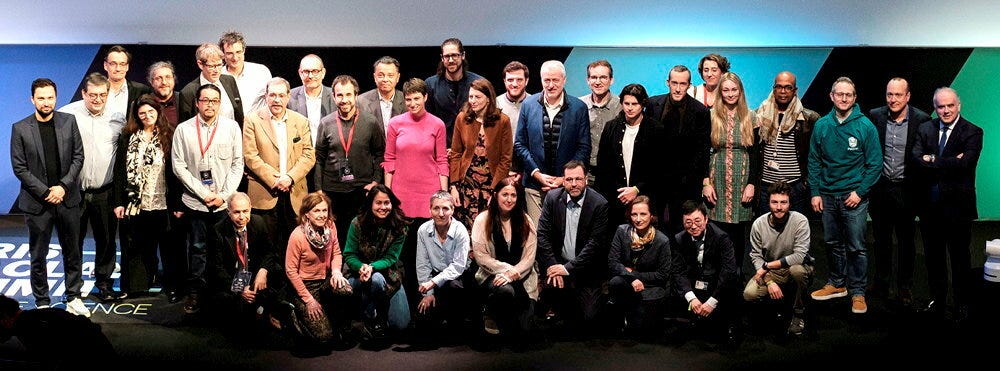
This happens very rarely in Europe, or at least in France, I’ve never heard of any opportunity like that.
For a second point – the difference of mindset and culture.
In my opinion, there’s a lot of taboo about several things [in Europe], like talking about the wage, the attitude that one should not brag about how much you make or you should not be too ambitious, and your history of failure being something you have to carry on your back. And what I found very refreshing in the US is how people are enthusiastic about my work, my ideas.
Even the Uber driver, when I had the [Strange Loops] mask on the way to my performance in SF, asked for my number so he could say he knew me when I got famous.
The good side of Europe is the richness of culture; the art, the food, and also several avant-gardes actually come from Europe: British punks, Dada. So I think there’s still some boldness in Europe, they just need a little push for the entrepreneurship side.
So you did your Masters in computer science – I’m curious then, why neuroscience, why dreams?
Even from high school, I was very curious about understanding how all the mind works. The structure of the mind, that’s something that’s interested me through time.
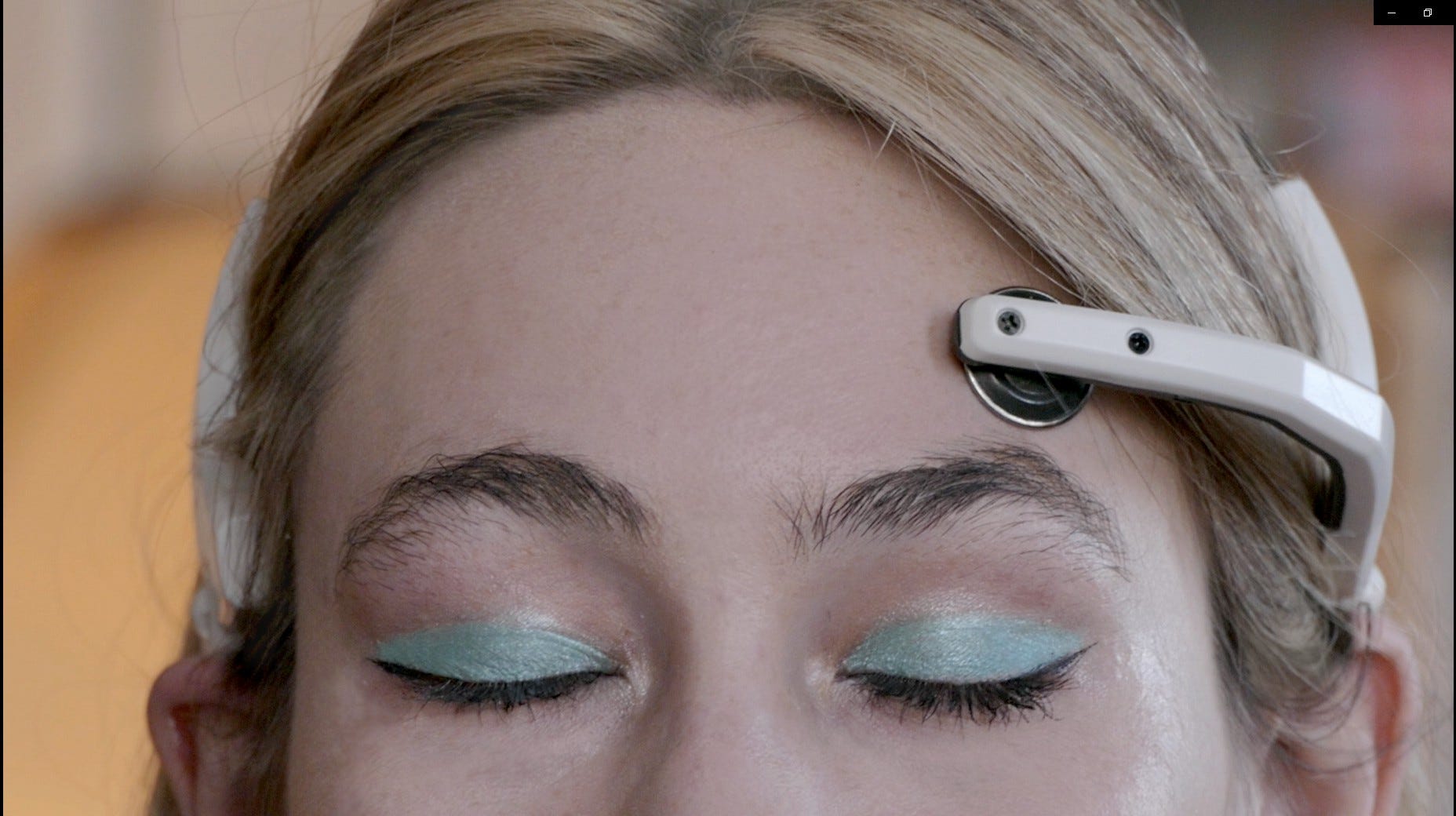
I was trying to understand how my own brain works for a long time. My first job after university was studying the psychophysics of synchrony perception in music - basically doing psychology experiments on karaoke.
I was also studying the phenomenology of time in cinema, so in the background [of my mind], I was always very interested in this quest for consciousness or how time is perceived.
For the dream part…it’s a bit personal. My grandfather was a veteran who suffered from PTSD nightmares. And this started my obsession with the science of dreams.
So I started sleeping wearing a brain sensor every day, annotating my dreams when I woke up. I read everything I could find on dreams from computational neuroscience, poetry on dreams, psychoanalysis, everything. And there was one book in particular, the Paradox of Sleep by Michel Jouvet.
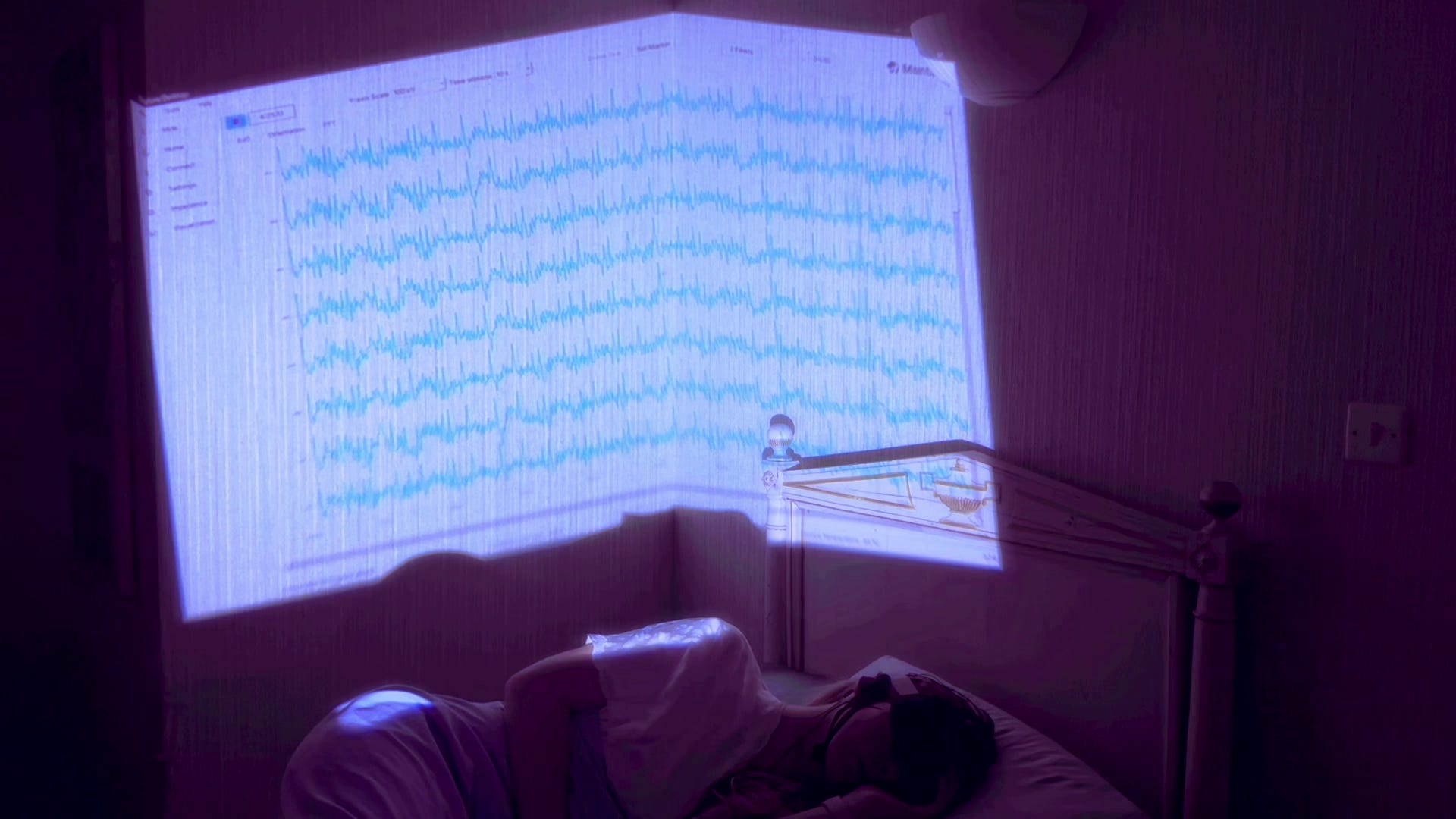
One theory that really resonated with me is that part of the dream is encoded in the DNA. That perhaps dreams are this moment when you can negotiate with your genetically programmed behavior, and you can deviate from it to become your true self.
One of the biggest challenges that we have right now with decoding dreams is just that there’s not enough data. There’s also not a universal decoder where we can pattern match exactly what is going on.
I use myself as a test subject, have a list of beta testers, and I recently secured the largest data set of annotated dreams with lucid dreamers. So we actually have a data set that is quite huge – the world’s largest. But it’s still not enough data compared to other domains, like vision decoding.
But the key thing is understanding the relationship between visual perception and visual imagery - they share neural correlates but aren’t identical. I’m currently developing methods to quantify that distance mathematically.
So it’s not just the data - it’s building a proper foundation model that can learn representations across tasks like visual perception and visual imagery, then validate and transfer that to dream data. That takes time to do right.
There’s also hardware, getting stable, consumer grade for all-night-long recording.
So day to day, are you in the lab, or are you more focused on the exhibitions and your artwork right now?
Now it’s more analyzing the datasets and at night, I sleep with my sensors so it’s data all day long. But I try to maintain a balance between art and science and recently, I’ve been much on the science side.
It’s because it’s important for progress. I just got a paper accepted to NeurIPS for my brain decoding work, so I’m very happy about this. But I need to reconnect a bit to my artistic side. I turned down an exhibition proposal in Berlin last month, there are several opportunities I had to turn down.
I want to change that. I just set up a makerspace at home with a 3D printer, laser cutter, and camera setup. Yeah. Craft is very important also for me.


I’m trying to create the.. how to say this…I’m still developing the aesthetics for it. There are people who think my mask, which shows emotion, is also representing dreams.
But for me at the moment, they are two separate things. There’s the emotion and there’s the dream.
I recently met therapists in Switzerland who are interested in dream decoding for PTSD, so we’re considering doing trials together. So it feels like I’m trying to balance the therapy side, and there’s also the artistic, and consulting all together. In a single message. It feels like I’m trying to piece together all the different parts of my identity, crystallizing them into an artifact.
What does your process look like when you’re developing a research idea and then translating that to an exhibition? How does something go from the idea to the research, to the fab lab, to being in the galleries and displays?
The ideation process for Strange Loops is quite peculiar compared to my other projects, but perhaps it’s the one that matters most.
For a very long time, one of my biggest influences was conceptual art. So I used to start with the concept and make it a big, complex, philosophical thing.
Strange Loops was my final project for a program called Fabricademy. Originally, I had this super complex idea of a performance with a robotic arm – at the last minute, they told me, “sorry, we won’t be able to do this project.” For years, I had this idea! This was my masterpiece performance!
So I had to find a new idea in 20 hours.
And so the first idea I had was to make this brain interface that showed the emotion of the wearer. It was an instantaneous idea, I didn’t overthink or anything. So I think when you don’t think too much actually you can tap into a quite deep subconscious layer.
I think this came to me so quickly because I’m someone who thinks a lot in colors.
In the supermarket when I was kid, I used to sort every item in the store by colors. In rainbow order. And still today, I don’t remember the metro lines, the train stations, by number, but by color.
So I knew I wanted to communicate feelings through color. There was this painter, Kandinsky, who wrote about the grammar of color, how color can be a language.
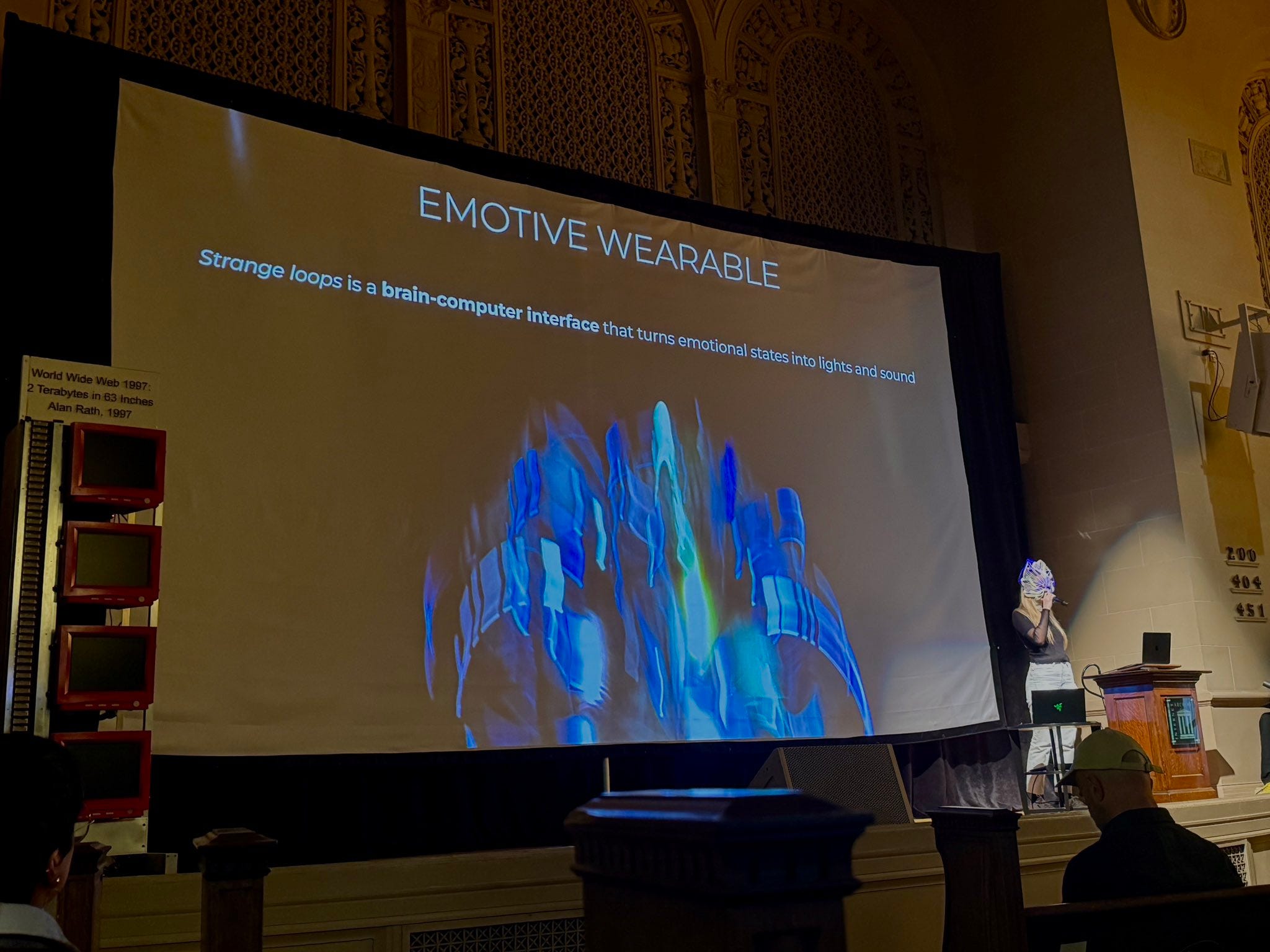
After that, I was lucky enough to be approached by people who also wanted to showcase my work. But I’ve also applied to exhibit quite a lot in academic settings. For example, last year, I did a presentation at the Augmentation Summit (held at the MIT Media Lab) about my Strange Loop costume – the second part of Strange Loops. It’s a body suit with all the same aesthetics, the optic fibers and additional sensors.
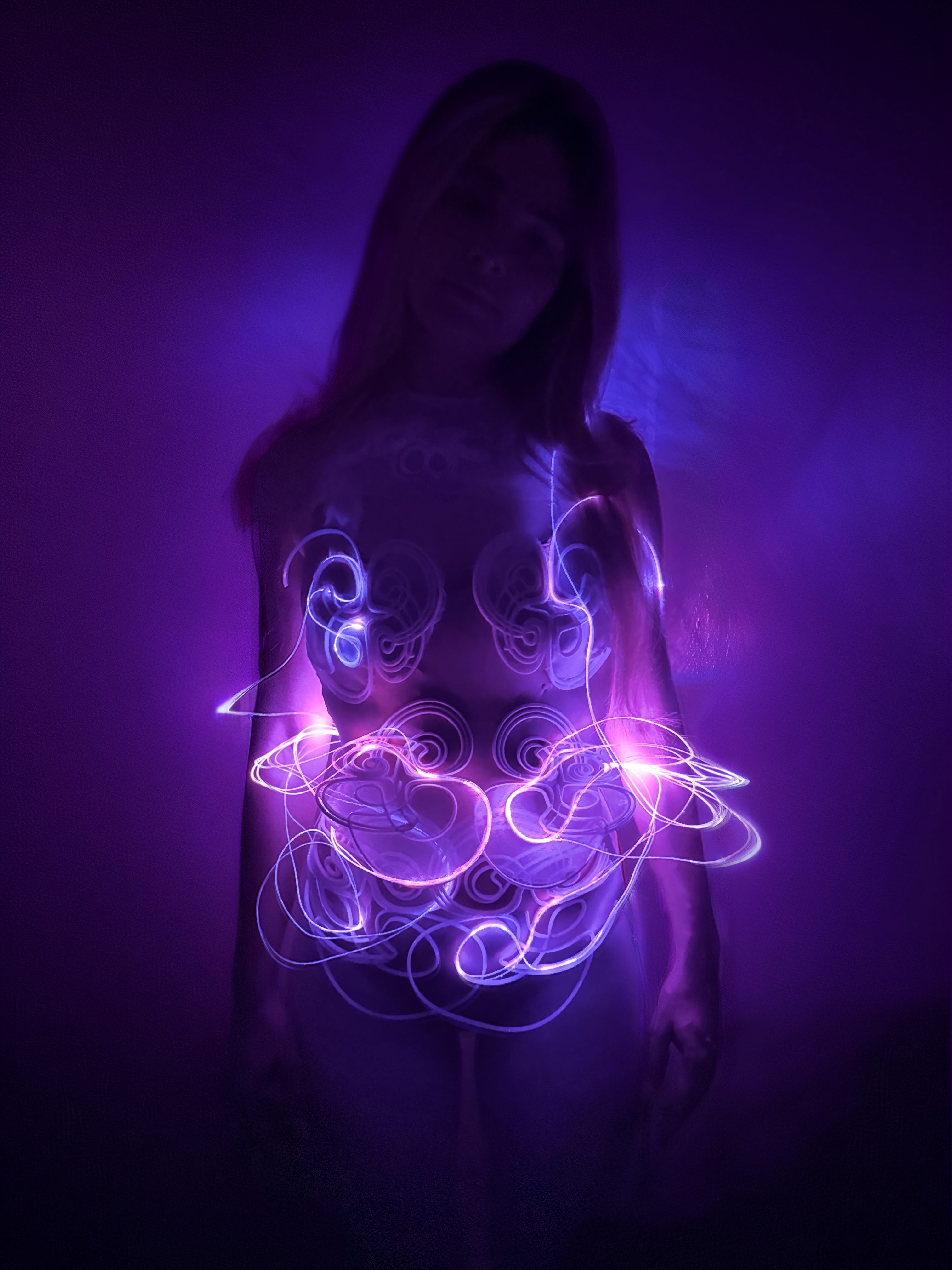
Once, I was in the elevator of Media Lab with the mannequin with the costume. Some guy enters the elevator and says, “hey, I know one fashion tech designer in San Francisco who would love what you do. Let me connect you!”
And so that’s how I eventually connected with the whole community of creative technologists in San Francisco and ended up doing a brainwave music performance at Internet Archive [with TIAT].
Do you think about each piece individually or are they tied together? Strange Loops has two parts – when it comes to all of your work, do you see them as individual pieces or as part of one big collective?
Yes, a good question. My mask and costume are part of the same costume, so when I presented it at the Augmentation Summit, it was part of a series. For the future, I’m thinking about including dreams in the performance, maybe a live streaming of my dreams, including a bed in the performance, all one entity.
When I started my career in art, I was doing mostly interactive installations. Something with a screen. I was doing AR installations before they were called AR; but I realized last year that my art cannot be separated from the body. It has to be worn or performed.
That’s why I make wearable technology or performance art now. And it resonates with me so much more.
The body is the extension of the mind, and then a lot of the art that you develop is an extension of the body.
Yes. Stiegler talks about cortex and flint mirroring each other - the self emerges through technical reflection. That loop is where I recognize myself through my art, where I become.
I think this is also a good part to mention, like your fashion sense is incredible. Your outfits on Instagram are incredible.
Oh, thank you! I think art and science also interplays with my fashion. I’m working on a brain-computer interface catwalk in SF.
That would be so cool.
Next year. Stay tuned.
We talked about failure a little bit earlier.
What’s one big failure or redirection that you actually secretly loved or that taught you the most?
I’d been rejected from MIT Media Lab several times before getting in.
I haven’t really “failed” because I eventually got what I wanted - I’m now an affiliate at the Media Lab. But the first rejection, I thought I didn’t have enough awards or credentials. So the next year I published 10 papers, kept pushing, and got rejected again.
That’s when I decided to go to Cambridge and actually meet the people. And that changed everything - going to the US, going to conferences, meeting collaborators.
The irony is my original dream was to do a PhD at the Media Lab. Now my dream is to carve my own path independently. I realized with dream decoding, my vision for art and science, I can pursue it on my own. I learned this while trying to reach the Media Lab - I was an independent researcher for two years, publishing constantly, exhibiting everywhere. And even when I succeeded [in getting the position], I realized I didn’t need institutional academia as much as I thought.
You can’t plan a lot of your success if you’re someone who believes in an emergent life.
I agree 100%. This mask, this project, it started when I stopped caring about just academia, just credentials. I realized when I do what I love, people actually resonated with that more. And the success came afterwards.
One of my instructors at university told me that the job I would eventually do didn’t exist at the time. I remember it because it’s true. I never fit in the boxes of existing art or existing science.
And it’s okay not to fit in the existing boxes. Build your own.
When you look at your own work, what is the feeling you get from it? I know this is an oversimplification. There’s a lot of different emotions here. And secondly, do you think that is the same as what the audience feels?
When I see the entire body of my work, I feel joy. I’m genuinely proud of everything I’ve accomplished.
I’ve performed brainwave music across three continents. So I have a sample of different cultures and audiences – I’ve had people cry while listening to my music on stage. I’m not happy that people cry, but in a sense, people are moved. It can be intense.
The feeling depends on the audience. When engineers or signal processing people see my work, I’m not always sure they understand the depth of what I’m doing.
But I’m not trying to prove anything to anyone. I don’t care about judgement. At some point, they’ll have to get used to [the intersection of art and science].
This next question from our last guest. Are there any artists, scientists, or works that not only inspire you, but that you use to ground yourself, to calibrate your eye and taste?
Quite a lot actually.
My calibration axis runs from Turrell’s Ganzfelds [Light and Space], art that looks like psychophysics experiments, to the anti-retinal conceptual works of Duchamp and Kosuth - artists who use light and language as material.
Joseph Kosuth was one of my first loves in high school. It was really conceptual art with messages in light, the kind of art that people said, “this is really pointless.”
But I was really a big fan. It’s the background of my computer! I won’t share my screen because my desktop is a complete mess. [laughs] But right now my background on my screen is the artwork “Titled (Art as Idea as Idea) [Medium]” by Joseph Kosuth.
I forgot this was my background, gosh, because it’s so messy that you can’t see anything. [laughs again] But this has been my background since high school.
I like Yves Klein - the Anthropometries body-print performances and the Monotone-Silence Symphony, violins playing the same note for twenty minutes, and then silence. And they dip their bodies in blue paint and make prints with that. I resonate with that a lot.
A book I constantly return to is Gilbert Simondon’s Individuation in Light of Notions of Form and Information, which structures how I think about machines and beings becoming.
Onto you, then. If you were to leave a question for the next guest, another creative researcher, what is a question that you would want to ask them?
Before I answer - I thought I was going to get the question from Nick [Desnoyer] because I saw it was the last piece [on the Dossier]. So I was preparing myself to give an answer to his question – “what is the meaning of life?”
It’s simple for me. The meaning is the food, the art, the truth, love. This is what matters the most for me.
You prepared very well for that question.
I would ask the next person: “what is your vision of art and science and how do you keep the balance between those two dimensions?”
I would want to see if the person sees art just as a cosmetic for popularizing the science, if art is just serving the science or if science is serving the art.
That’s an incredible question. That’s Ninon – thanks so much for joining us.
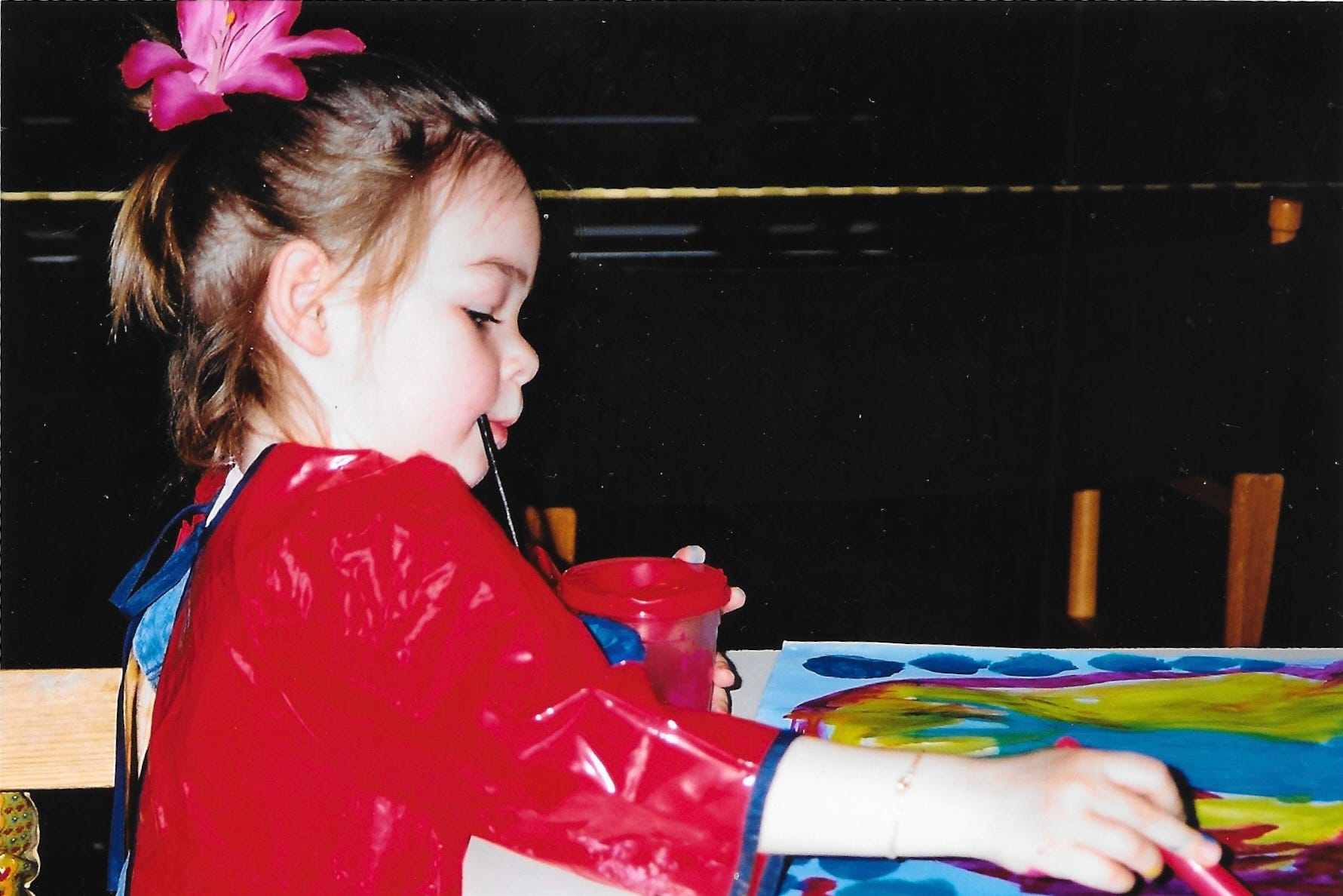
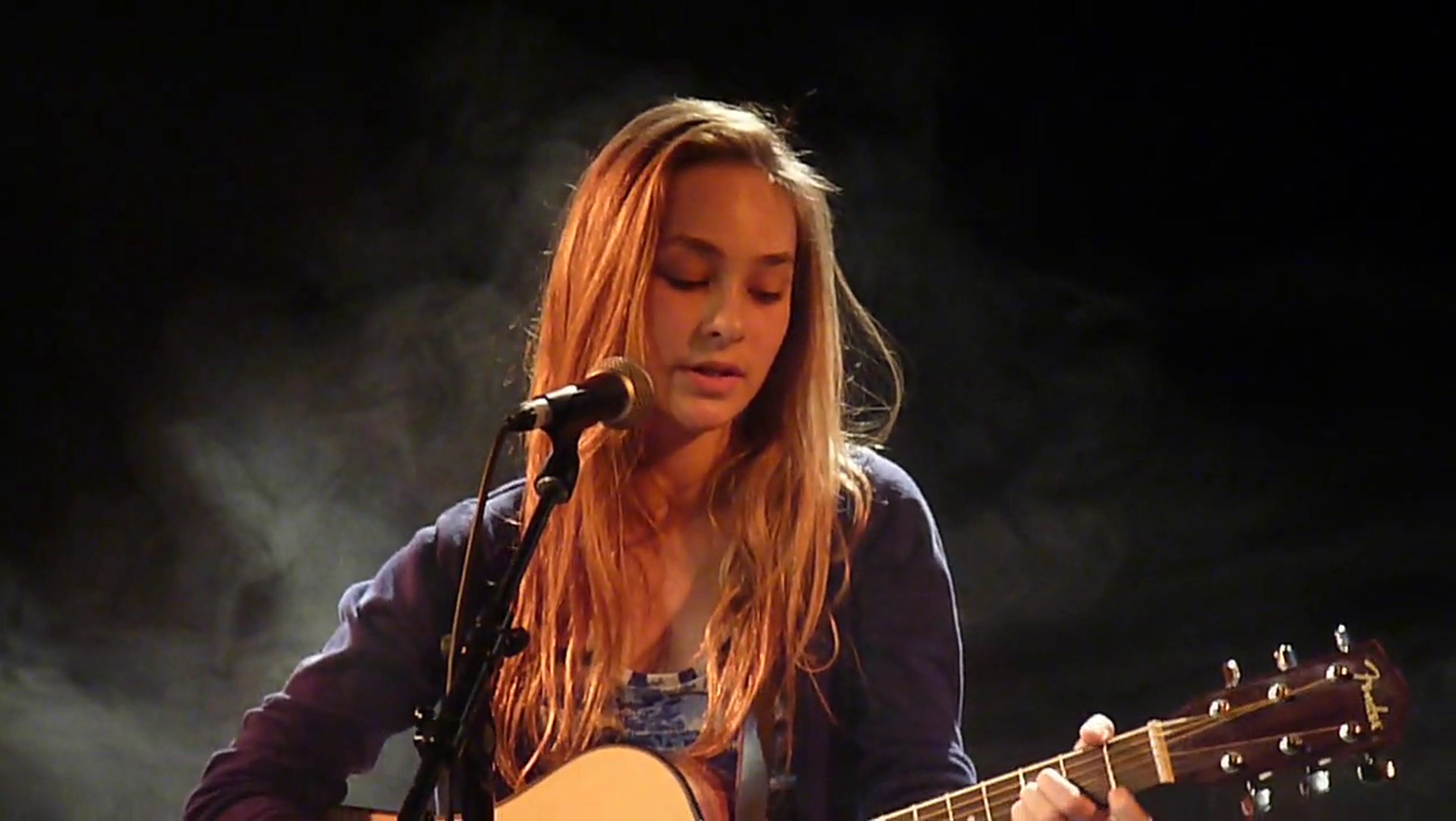
Author’s Addendum (post-publication). Something important that shaped who I am and what I’m doing today (wearables and performance) is my acting/theatre debut and my hometown’s music open stages where I regularly performed as a kid.
My love for costume and performance began at 9, singing in an 18th-century court gown accompanied by harpsichord in the historical TV film L’Enfant du Secret (dir. Serge Meynard, 2006) on French national television. This moment started my fondness for costumes, characters, and historical reenactment. I still dream in theatre plays. — Ninon
Such a great interview and such beautiful work from both of you.
Let's gooooo