


Entry 004: The Next Bell Lab is Already Here. It's in One of the Frontier AI Firms.
If a 21st-century Bell Labs were to emerge, who could actually run it, and what would it look like?

Welcome to The Distressed Scientists Department, an experimental lab on paper exploring the art and ache of scientific research in the 21st century. If you’re new here, I’d like to invite you to read the manifesto.
For this piece, a financial appendix with projected capex and stress tests is also available, for context as you read.
When I read Jon Gertner’s The Idea Factory for the first time at age 15, I remember a crescendo of excitement, page after page. For the young science obsessive, Bell Labs was a promised land.

Then I learned that the lab had sunsetted two decades before I was born, and by the time I entered kindergarten, only four scientists remained in its physics department.
At its mid-century peak, Bell Labs filed ~503 patents per year (incredibly, more than one per day), an output-per-researcher ratio no modern institute has matched. When I present those numbers to friends, the immediate question is, Why don’t we have a 21st-century equivalent – and what would it take to build one?
We probably won’t get a single, hegemonic R&D behemoth again. Capital and talent are widely distributed; even Google X, created downstream of the Web 2 boom, doesn’t dominate the way Bell once did. Modern corporate labs also tend to narrow into domains: Verily lives inside biomedical; Toyota Research focuses on robotics; Arc Institute (note: independent of Stripe) focuses on life sciences. Concentration makes strategy cleaner, but it also siloes discovery. If every major lab chooses a single niche, who funds the weird cross-disciplinary moonshots? Which organization today is even capable of running a laboratory that is both cross-disciplinary and industrial-scale?
The firms that sit closest to the AI frontier – OpenAI, Anthropic, and Google/DeepMind – operate at the interstice of nearly every scientific and commercial field and control a capital & compute stack large enough to bankroll decade-long, multi-domain research. This combination makes them the most plausible hosts for the next corporate R&D lab of Bell-era scope, even if they never match Bell-era market share. Here, I want to explore what that could look like.
Disclaimer: I have never worked for any of these organizations, and much of their internal data is understandably private. For all we know, the idea of creating a corporate R&D lab may already be in the works or completely scrapped. I also do not claim that frontier AI firms are the only solution to the innovation gap: in fact, I outline some caveats and the way such a lab could go wrong. This is deliberately an overview.
If you’re actively building or funding something similar, or want to chat, you can find me on X, email joliegcy@gmail.com, or DM me on Substack.
For now, this is a map that covers:
Historical pattern-match. Why explosive cashflows & existential stakes produced Bell Labs, Xerox PARC, and BP Venture Research — and how the same macro pre-conditions are re-emerging around frontier-model companies.
Current behavioural signals. Residency cohorts, PhD fellowships, and venture micro-funds that mirror the gestation phase of past industrial labs.
Case for an internal, broad-spectrum lab. Benefits, risks, and realistic caveats, including a blueprint that outlines what such a lab might look like and what constraints are already in place.
Open questions. Governance, environmental footprint, and whether any of this could stay “open science” while AI remains the organizing principle.
Why entertain the industrial lab question at all?
After all, the 2020s look nothing like the era that birthed Bell or PARC. Basic (and complex) scientific research exists through Focused Research Organizations (FROs), venture studios, and even lone researchers on arXiv armed with a weekend’s worth of Colab credits. If intellectual horsepower is already so “democratized,” and no single lab could plausibly corner the market for breakthroughs the way AT&T once did, why drag the idea of a chartered, cross-domain R&D house back into the debate?
The question isn’t whether alternative research vehicles exist — they do, and many have earned their place. The real question is whether we can afford to ignore a once-in-a-generation alignment of capital, talent, and urgency.
When I refer to an industrial R&D lab, I mean something that is:
Committed to open science wherever possible
Oriented toward broad public benefit
Unconstrained by narrow domain silos, in other words, built to support interdisciplinary work across and between fields
Designed to support multi-year, high-risk projects with real runway and infrastructure
Noah Smith already explored this in 2022 with his piece “The Dream of Bringing Back Bell Labs.” But since then, capital and compute have concentrated even further — OpenAI's training runs cost hundreds of millions, Anthropic raised $4B. The concentrations of compute and capital could make such a lab all the more possible.
Wait — don’t R&D arms like Google X and Google Brain already exist?
Yes, these research arms exist (actually, Google Brain no longer does), but I want to posit what it would look like if a firm focused primarily on AI led this. Google’s sprawling research apparatus, with Google Research, DeepMind, X, Verily, and others, creates many confounding variables. For the sake of this argument, we’re focusing on leading AI firms specifically. I’ve included DeepMind not as part of Google’s broader research empire, but as a distinct AI-native organization also owned by Alphabet.
Historical Preconditions & Incentive Patterns
Several historical examples help illuminate what makes a broad research lab succeed. Across very different eras and industries, the broad R&D giants that moved the needle all ran on the same six “structural nutrients.” The table shows how those ingredients manifested at Bell Labs, Xerox PARC, BP Venture Research, and Philips NatLab.
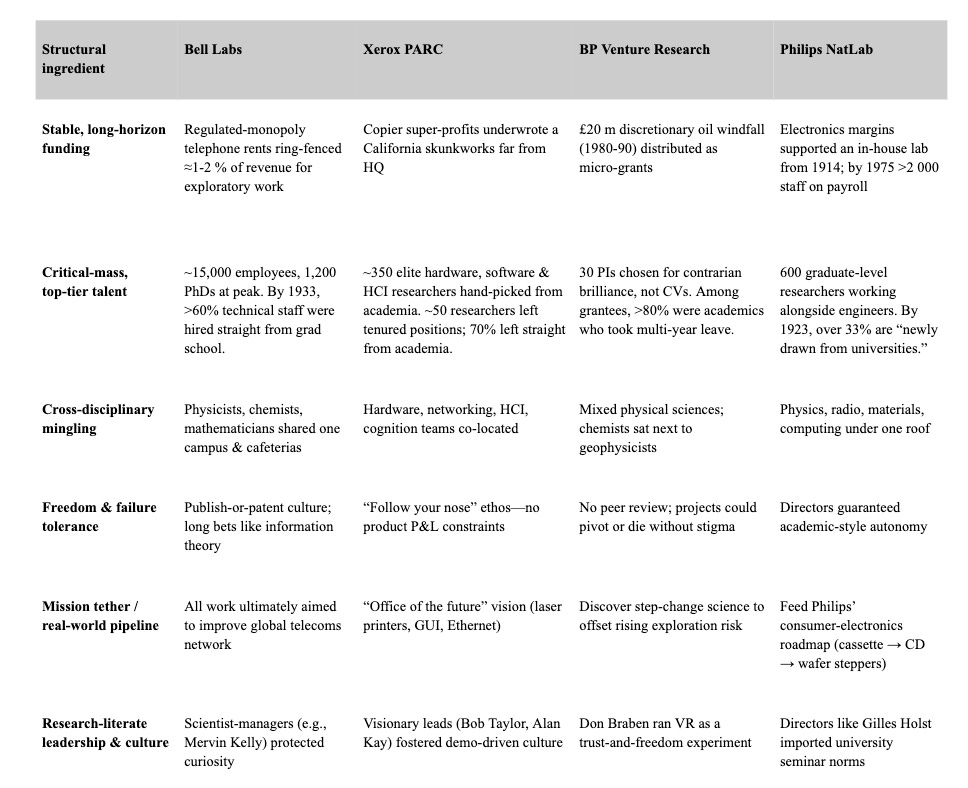
Are today’s frontier AI firms in a position to emulate (not replicate!) any of this? Interestingly, we can already see early signs that they are following similar patterns in gestation. The same six “nutrients” that nourished Bell, PARC, BP Venture Research, and Philips NatLab are already sprouting inside the three compute-sovereign AI companies — only the scale and tempo have changed.
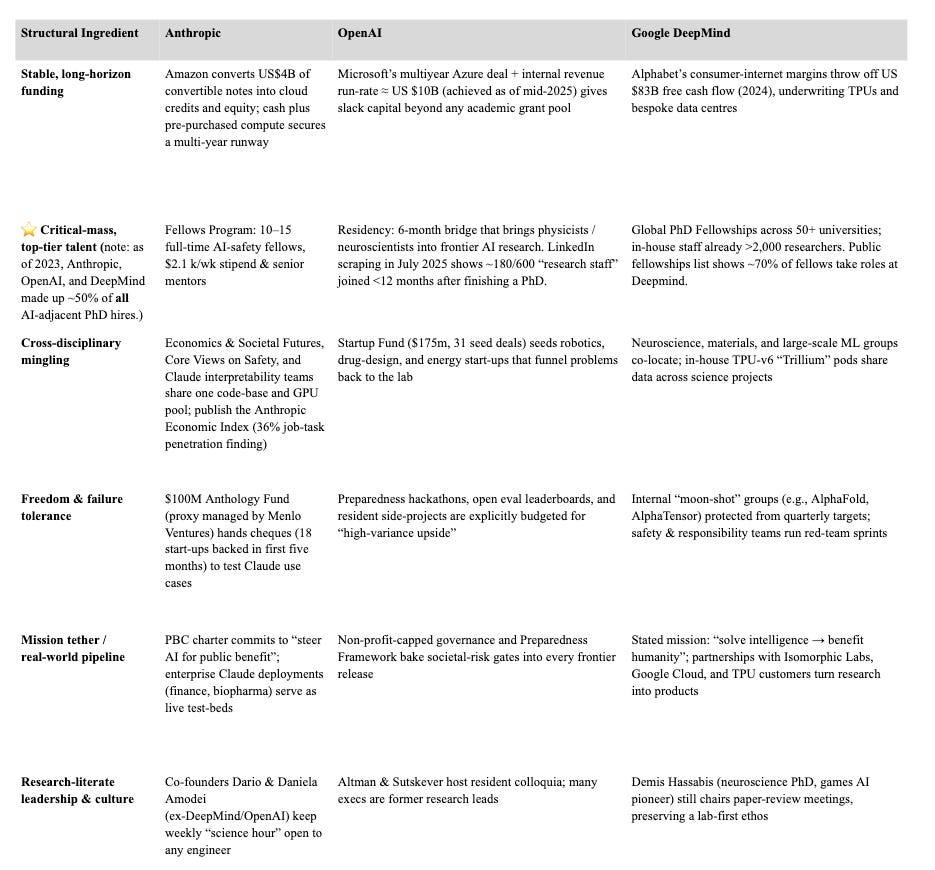
Why Frontier Firms are Best Suited Today:
Three forces point toward housing a cross-domain R&D lab inside frontier AI companies:
Chronic under-investment in fundamental research.1 While businesses spend heavily on R&D, most goes toward product development rather than open-ended research. Fundamental research is a public good—its benefits diffuse far beyond the inventor, so private firms underinvest. Universities excel at deep science but often stay siloed by discipline, missing the "use-inspired" basic research that mid-20th-century corporate labs excelled at. We're under-investing in the kind of fundamental yet application-oriented breakthroughs that fuel economy-wide progress. Note: I address other models, developed post-Bell Labs, that indeed fill some of the R&D gap; see more in the footnotes.2
Frontier-scale compute costs that exclude most actors. If the 20th-century labs thrived in part because of an abundance of the “technological currency” of that day and age (e.g. AT&T’s telephone monopoly funding Bell Labs), we should ask: what are the “unique conditions” of today?
Compute chokepoint – Compute power is the new coin of the realm. Most models that exceed regulatory compute thresholds come from three major AI labs - OpenAI, Anthropic, and DeepMind - and only select organizations have the technical infrastructure to routinely conduct such large-scale training runs.3
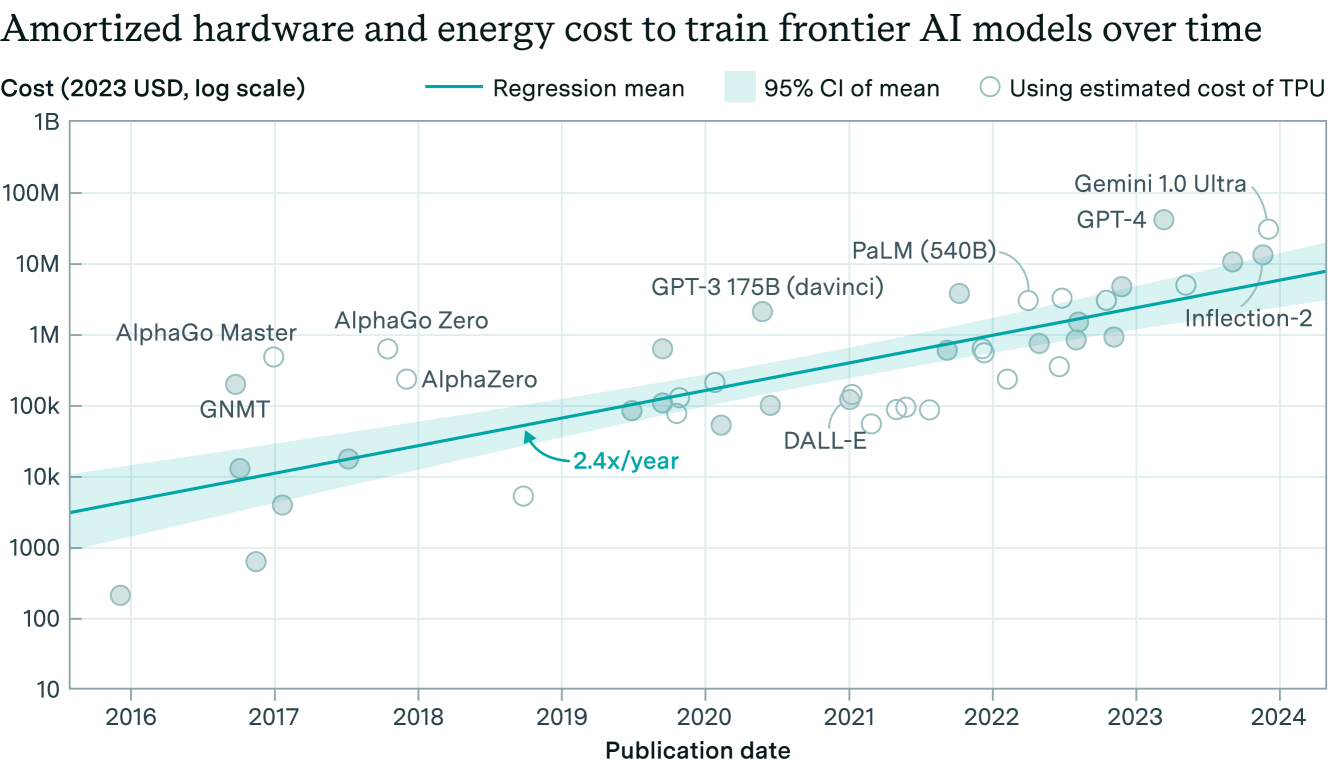
Concentrated capital – Training at the 10²⁵ FLOP scale costs $7-10 million, while 10²⁶ FLOPs costs $70-100 million. These same firms have already secured multi-billion-dollar dry powder (e.g., Microsoft’s $10B OpenAI deal, Alphabet’s >$70B annual free cash flow, Amazon’s $8B cloud-credit line for Anthropic), letting them absorb the next order-of-magnitude jump in training costs without outside capital.
3. Social good and rapid feedback. In an environment where policy cycles lag technology cycles, the frontier firms that generate the shocks are also the best-positioned actors to act fast enough to measure them. Each already runs public-facing programmes—Anthropic’s Economic Index (which found 36% of U.S. job tasks already touch Claude-class AI), OpenAI’s Preparedness Framework with safety checkpoints, DeepMind’s embedded Responsibility & Transparency teams — but they remain siloed. A chartered, cross-domain lab could fuse these efforts into a single loop that captures real-time externalities, feeds them straight back into product design and alignment research, turns private capacity into a durable public asset, and signals the kind of transparent stewardship that sustains (at least the appearance of) public trust, which we know frontier firms care deeply about.
Suitability Checklist - Who Could Actually Run Such a Lab?
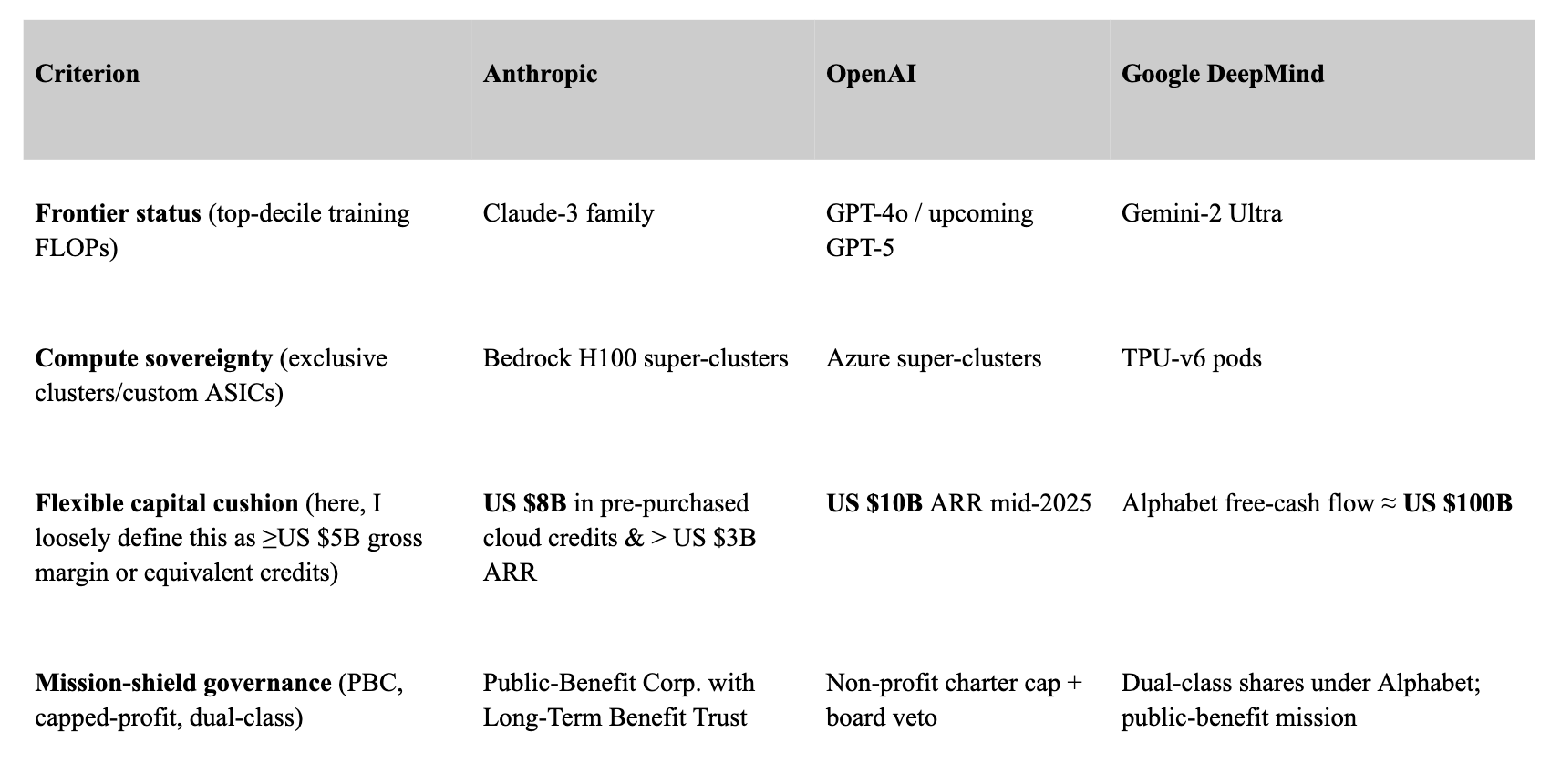
See here for a justification for US $5B as the capital cushion.4
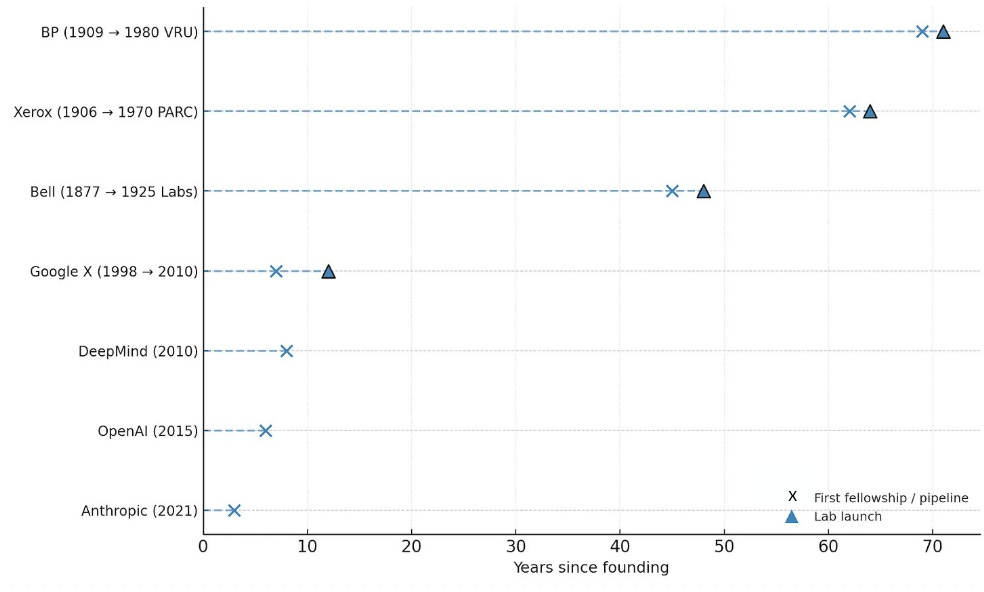
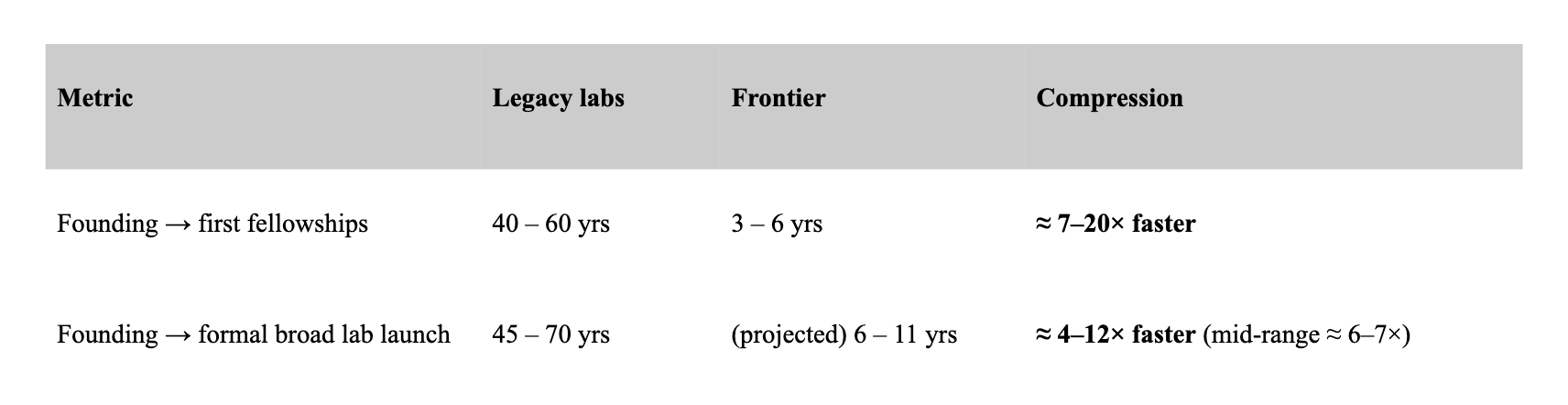
Why an Internal R&D Lab Could Make Sense for Frontier AI Firms
What’s in it for the firms? Or, alternatively, instead of ambitiously creating a big internal R&D center, why don’t these companies just invest externally – say, fund universities and startups, and deploy capital through proxy GPs – and reap the benefits of innovation through partnerships or acquisitions? Big firms often choose to buy innovation rather than develop it in-house.
But just as AT&T quietly seeded Cooperative Research Fellowships in 1972 before scaling Bell Labs, Anthropic, OpenAI, and Google DeepMind are already laying down smaller blocks: fellowships, micro-grant funds, in-house benchmarks, hackathons. These moves hint that the firms have realized compounding internally, including a potential lab, is not charity but a strategic lever that:
(i) compounds core-model capability,
(ii) deepens competitive moats, and,
(iii) innoculates them against looming compute licensing and trust regulations.
There are several strategic reasons why housing a broad R&D lab within an AI frontier firm could make sense, even if not right now, in the near future:5
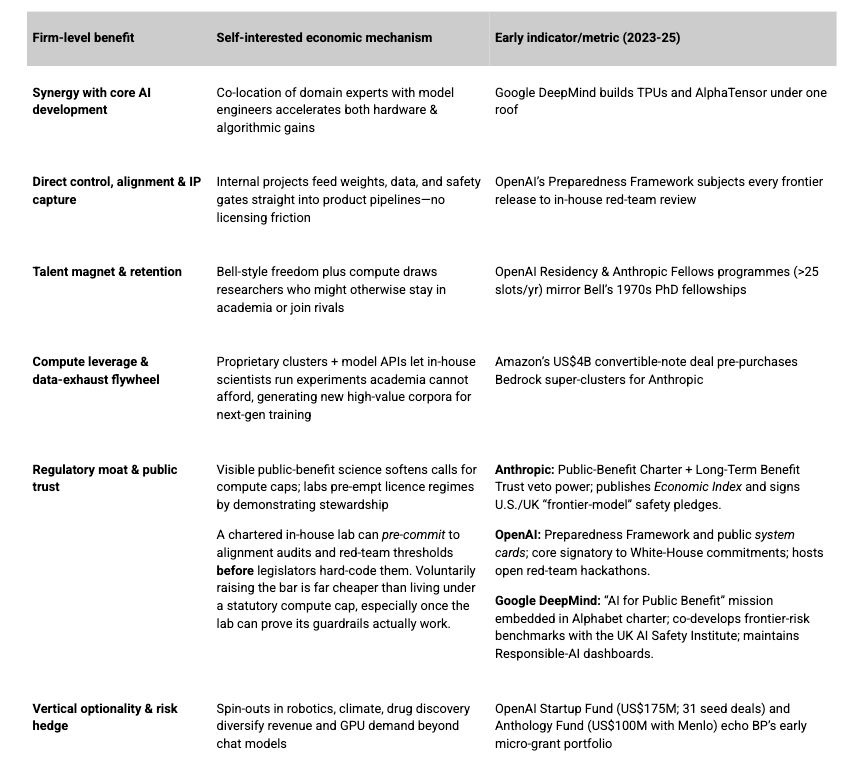
The signs are there. Capital, talent, compute, and public mandates have all converged at a handful of AI labs that are, knowingly or not, retracing the steps of the 20th-century research giants. But pattern-matching alone isn’t enough.
Designing the Lab: an Operating Blueprint
The strategy isn’t to copy what Bell Labs did right. Legacy labs thrived under 20th century conditions that we’ll never see again: for instance, multi-decade product cycles and thick buffers against public scrutiny no longer exist. Frontier-model AI firms sit on a very different playing field – they are GPU-constrained, capital-intense, and culturally porous, with safety expectations measured in months, not decades.
Before you get too far, I’d like to note that I created a financial appendix with projected capex and stress tests, which might be helpful supplementary context as you read this section.
Key Design Considerations
These are the core design principles that guide 21st-century thinking. Read this as a blueprint, not a report: it is enough structure to see how these principles could mesh, but intentionally loose enough to adapt as the frontier shifts.
1. Mission Alignment
The blueprint directly incorporates the stated missions of all three frontier AI companies:
OpenAI: “Ensure that artificial general intelligence benefits all of humanity”
Anthropic: “Build reliable, interpretable, steerable AI systems”
Google DeepMind: “Solve intelligence and then use that to solve everything else”
2. Safety-First Architecture
Drawing from Anthropic’s Responsible Scaling Policy and OpenAI’s Charter emphasis on “long-term safety”, the blueprint embeds safety considerations throughout:
Responsible scaling checkpoints in capital budgeting
Safety evaluation gates for resource allocation
Dedicated safety research compute quotas
Constitutional AI methods sharing for transparency
3. Beneficial Applications Focus
Reflecting all three companies’ commitment to beneficial AI:
15% GPU allocation specifically for “beneficial AGI” research. We use GPU hours as the budget anchor (unit of scarce input), a more reflective example than just dollars and/or number of PhDs.
Humanitarian use case prioritization in spin-out processes
Scientific domain groups aligned with core areas of interest (to expand upon over time)
Open licensing preference for beneficial applications
4. Collaborative Governance
Incorporating OpenAI’s “cooperative orientation” and all companies’ emphasis on collaboration:
Academic exchange programs for researchers
External co-funding with universities and government agencies
Open publication for safety research
Cross-disciplinary team structures
5. Interpretability and Transparency
Central to the mission and echoed in safety research:
Dedicated interpretability pods with sovereign compute
Constitutional AI methods development and sharing
Transparent cost ledgers and decision-making processes
Default open publication for safety-related research
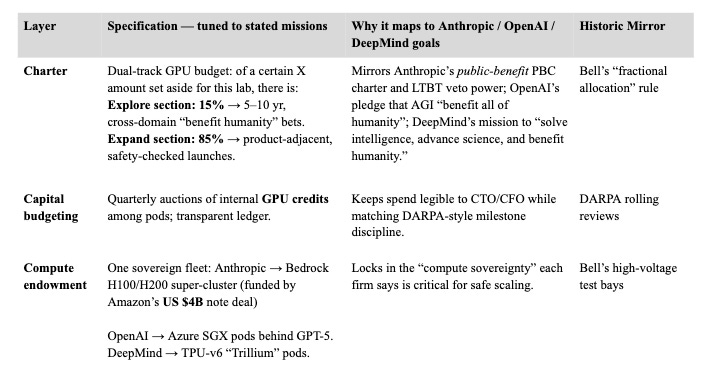
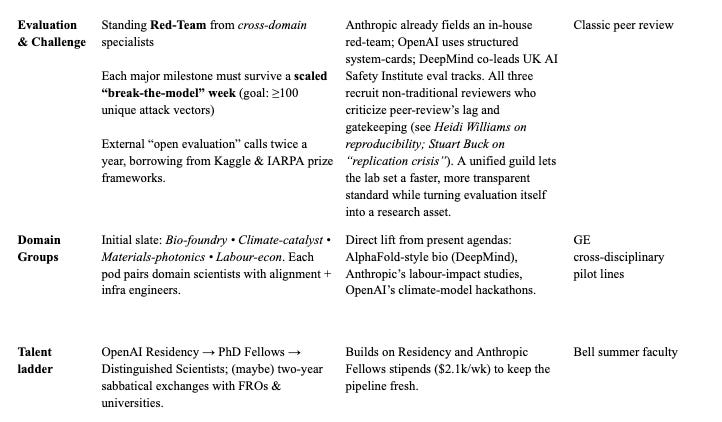
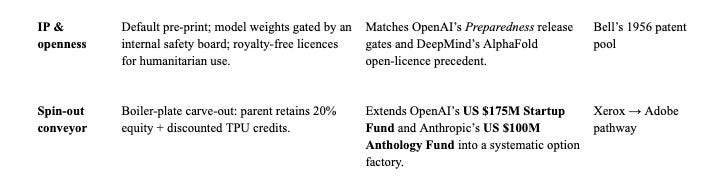
The matrix below wires those stated goals into concrete operating layers.
How the Pieces Fit Together
Charter hard-codes patience.
A standing rule that 15% of annual GPU hours from a designated budget flow (reiterate: as part of a designated budget, not the entire budget) to an Explore track fulfils each firm’s public-benefit pledge while preventing cannibalization of blue-sky capacity. Ideally, the proportion that Explore receives grows over time; an initial 15% is low enough to be politically palatable, then expand as the lab proves its yield.6
Turn GPU into the true unit of account.
Domain groups share a pool of compute credits every quarter, pushing teams to reveal real opportunity cost and killing zombie projects, borrowing from DARPA’s (and some of Google X’s) “program-manager fiefdom” playbook. This may be subject to change, especially as GPU costs change and track record grows; feedback is welcome.Sovereign compute keeps regulators calm.
Because the lab owns an entire training stack, Anthropic’s LTBT Board or OpenAI’s Safety Council can pause a risky run, making “alignment brakes” enforceable in practice.Domain groups.
Some possible domain groups: Labour-economics feeds Anthropic’s Economic Index; Bio-foundry extends DeepMind’s AlphaFold lineage; Materials-photonics supports OpenAI’s hardware co-design agenda. Each domain group has a crisp, externally legible objective to avoid mission sprawl. (Note: I struggled most with this one, see more in footnotes).7Residency-to-Sabbatical ladder compounds talent.
Early-career hires stay because they can pivot across pods instead of quitting for academia — exactly how Bell turned post-docs into long-term in-house researchers — and senior academics rotate in for two-year PM stints, à la DARPA.Publish-by-default earns licence-to-operate.
Pre-prints, open benchmarks, and humanitarian licences show regulators concrete stewardship, reinforcing the firms’ voluntary safety commitments. A governance panel vets dual-use or competitive-sensitive findings before release.Spin-outs recycle risk into upside.
Standard carve-outs plus cheap TPU credits turn successful pod outputs into new revenue streams—hedging the chat-model business while seeding entire markets.Open-science rails keep the flywheel honest.
- Transparency: public annual report of compute spend and spill-over projects.
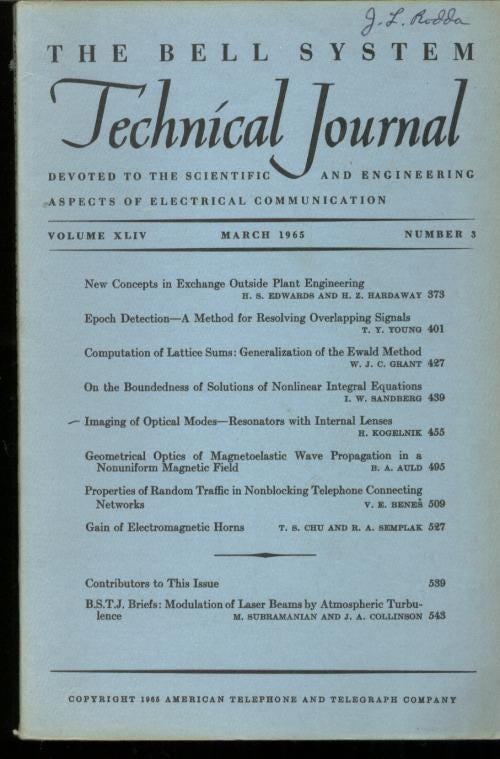
- Collaboration: joint calls with FROs and academia for co-authored milestones, echoing Bell System Technical Journal symposia.
- Reciprocity: any external dataset or model that crosses the lab boundary returns improved, with documentation and reproducible code.
You might be wondering — doesn’t an “AI-centric” mandate contradict the values of true open science, covering a wide range of domains? Recall that Bell Labs grounded its ventures and research in anything “communications-oriented” as a constraint, but was extremely flexible in practice. AI is a similarly broad general-purpose technology (probably the broadest we have at the time of writing) that lets us explore an n-finite array of disciplines.
Ethics & risk guardrails are embedded, not bolted on.
An independent “Red Team”8 stress-tests every high-stakes project; dual-use research of concern (e.g., biorisk) follows a secure-compute protocol and tiered-access publication model.
Net effect: compute is priced, patience is protected, spill-overs are published, and safety is proactive.
A speculative example: Imagine OpenAI’s R&D lab five years from now, structured across six domain groups: Core AI Research, Alignment & Ethics, Physical Sciences, Biology & Health, Computing Infrastructure, and Social Sciences. (All hypothetical.)
Teams use GPT models to design new battery materials (partnering with national labs for fabrication), predict mRNA vaccines from genomic data, and develop optical interconnects that cut AI chip energy use by 5x. Core AI invents new architectures inspired by internal neuroscience findings. Alignment researchers create industry-standard auditing tools. Social scientists embed with policy teams to guide educational AI deployment based on empirical studies.
Most findings are published openly: white papers, open-source tools, policy briefs, except sensitive work shared under government agreements (echoing Bell Labs’ WWII protocols). OpenAI gains multiple benefits: staying ahead of academic surprises, capturing IP from chip innovations, spinning off battery startups, and building public trust through healthcare and climate breakthroughs.
This vision is admittedly ambitious and comes with significant challenges.
Risks & Open Considerations
History says the danger is less a single catastrophic failure than a slow drift: incentives warp, budgets tighten, governance lags, and the lab that was meant to widen the frontier collapses.
This section “red teams” the proposal on two fronts:
External pressure-points — forces the lab cannot fully control (capital markets, public sentiment, regulatory shifts) but must anticipate and hedge against.
Internal failure modes — design choices susceptible to day-to-day politics, talent churn, or leadership/governance challenges.
External
Collaboration vs Competition: A challenge for an internal lab is balancing its collaborative scientific role with the competitive instincts of a private company. The lab’s leadership should delineate which areas are pre-competitive (where sharing is fine) and which are core competitive advantages to keep in-house. The labs might adopt a model that is open core: the fundamental research is published, but when it comes to training a giant model or building a product from it, that part remains internal. That way, others can build on the science, but the company still leads in implementation.
Capital Independence: these are private firms with investors expecting returns. Any perception that money is being “wasted” on what seems like science-fiction could cause backlash. Again, a common struggle of BP, Xerox PARC, and Bell was having a body run independently without financial and corporate realpolitik interference, something that they were afforded because the labs ran on their own revenue (see tables above), rather than investment. Frontier firms are still relatively dependent on external sources of money, especially given intensive burn rates.

The Court of Public Opinion: frontier AI firms are already the topic of hot debate, especially on Twitter. Essentially every move is scrutinized. Bets that don’t make immediate financial sense will raise eyebrows and will be searingly debated (how seriously these can be taken will vary, but it seems that each of these firms does strongly value their public appearance and optics).
Preventing brain drain out (or in): The success of such a research organization might turn talent away from academia or other important areas (so-called “brain drain”). We’ve seen top professors leaving universities for OpenAI or DeepMind already. If the lab covers many domains, that could intensify. Is that bad? Or is it just another choice for researchers to make? (For instance - Bell Labs pulled a significant number of PhDs and tenure-track researchers away from leading universities, academia survived.)
Environmental impact: A lab of this sort will consume, undoubtedly, copious amounts of energy and resources. Training giant models, running experiments – these have a carbon footprint. If the lab also does hardware or chemistry, there’s e-waste or chemical waste issues to manage.
Internal
Metrics of Success: Traditional business metrics (revenue, users) don’t apply neatly to a pure research lab. This has always been tricky for long-term R&D labs: how do you decide what to slash and what to keep given varying temporal timelines for projects? Instead, the lab might be evaluated on a mix of scientific impact (publications, citations, awards, invited talks – essentially, are they pushing the frontiers in various fields?) and strategic value (did their work lead to new capabilities for the company? Did it avert risks? Did it create options for new lines of business or societal contributions?) Some tangible outcomes could be tracked:
number of patents filed (though patents aren’t the best in fast-moving fields),
number of successful technology transfers to product divisions,
talent retention metric (are top researchers staying because of the lab?), and
external reputation (is the lab considered a top place to work by scientists? Are governments or universities eager to partner with it?).
A bit like how Google measures Google Research by its contribution to the state of AI, and IBM long measured IBM Research by its patents and Nobel prizes.
Leadership and Organization: Who would run this lab? Ideally, someone with one foot in science and one in strategy – much like Bell Labs had scientists in charge. The lab head (Chief Scientist type role) should report high in the company (maybe directly to the CEO or CTO) to have clout and protect the lab’s interests, but at the same time, operate independently enough to insulate the lab from influence (see Alan Kay’s notes on this). Finding someone like this has proven tricky for many R&D labs.

Governance and Oversight Volatility: Of the three firms, OpenAI has been notorious for the known for their leadership/governance changes - which makes oversight difficult. Bell Labs eventually struggled when AT&T was broken up – its funding got cut, priorities shifted. For an AI lab, if leadership changes or investors get impatient, the lab could be downsized or forced into short-term projects. One option is to involve external governance, but that muddies the pool and makes it more difficult to achieve open science independence (see above).
Alignment with Corporate Strategy: A potential failure mode is if the lab gets too isolated and “does its own thing” that is brilliant but irrelevant to the company. Part of the job of lab management is internally selling the importance of the weird projects to the suits. Bell Labs had it easier because AT&T was a monopoly with a broad mandate and regulated returns – today’s frontier firms live or die by market competition and investor sentiment. The lab will likely need some internal projects that yield medium-term benefits (to show impact) as well as the moonshots (which might be slow burn).
The parallels are instructive. Just as AT&T’s monopoly rents funded fundamental research, today's AI firms control a different kind of monopoly: the GPU clusters and engineering talent needed to push the boundaries of intelligence.
What makes this moment particularly poignant is that these firms are effectively the in-between of many of the contradictions we’ve explored. They have both the means (unprecedented capital, compute, and talent concentration) and the motive (existential questions about AI’s trajectory) to fundamentally reimagine how transformative research happens.
Some questions remain:
On institutional design: Can mission-driven research truly flourish within profit-driven entities? History offers mixed signals – Bell Labs thrived until AT&T’s breakup, while Xerox PARC invented the future but failed to capture its value. Even BP’s Venture Research team closed shop after leadership restructuring. What governance structures might protect long-term research from short-term pressures?
On time horizons: The greatest breakthroughs often require patience measured in decades, not product cycles. Can we balance this patience parallel to a race to achieve AGI, while also competing with the next market downturn, leadership transition, or investor update?
On measurement itself: We’ve inherited a scientific culture obsessed with metrics: h-indexes, impact factors, patent counts. But if not everything that counts can be counted, how might these new institutions measure success in other ways?
On access and equity: Who gets to shape these research agendas? The old industrial labs reflected their era’s exclusions, even if they were ahead of their time. New institutions must do better.
This inherent underinvestment was researched and established over 6 decades ago by Arrow and Nelson. It makes intuitive sense: Bell Labs invented the transistor, but AT&T reaped only a sliver of the transistor’s global value. Why spend millions on something whose payoffs you might not own? As a result, truly exploratory research tends to fall to academia or government grants.
Focused Research Organizations (FROs) and domain-specific labs have emerged to fill some gaps, but they are narrow in scope. In recent years, visionary scientists and funders have proposed new structures to tackle targeted problems. One model is the “Focused Research Organization” or FRO – essentially a mission-driven research startup that assembles a team to solve a specific mid-scale challenge in a fixed timeframe. FROs aim to create public goods (data, tools, prototypes) that traditional funding might overlook. Crucially, though, they are purposefully focused: each FRO tackles one well-defined challenge and disbands (or transitions) after a few years. This focus avoids bureaucracy and dithering, but it means FROs won’t create a broad, serendipitous ecosystem of innovation across domains. They are more like high-powered rifle shots than the expansive research culture that a Bell Labs fostered. Similarly, many large companies today have “labs” or R&D divisions dedicated to particular domains – pharmaceuticals have drug discovery labs, tech companies have AI or quantum computing labs, aerospace firms have propulsion labs, etc. These are important, but by definition they stay within a field. What’s missing is a place with the cross-pollination of multiple disciplines and the freedom to range across scientific fields that characterized the great industrial labs of the past.
What about philantrophy? Philanthropic initiatives like the Chan Zuckerberg Initiative and the Simons Foundation have provided crucial funding for basic research. That said, even the largest philanthropic research commitments pale in comparison to the compute resources now required for frontier AI development. The entire annual budget of the National Science Foundation ($8.5 billion in 2024) is less than the projected cost of training a single GPT-5 model. A single training run already costs more than most foundations spend on research across all disciplines in a given year.
Okay, why not just scale existing corporate labs, like Google X? The answer lies in the fundamental tensions between corporate quarterly pressures and basic research timelines.
Google X, despite its branding, has increasingly faced pressure to demonstrate shorter-term commercial viability, mostly from VCs who weren’t aligned with the initial principles of open science, driving out many folks who joined for the moonshot thinking. Projects like the neural network research inspired by fly brains were terminated not because they failed scientifically, but because they “lacked a clear path to monetization.”
This pattern reflects a broader trend in corporate R&D. Research by Arora and colleagues found that large corporate labs are unlikely to regain the importance they once enjoyed due to “greater product market competition, shorter technology life cycles, and more demanding investors.” The historical Bell Labs model succeeded because it was insulated from these pressures through regulatory protections and long-term funding commitments that no longer exist for most corporations.
With Meta and xAI rounding out the top 5.
A flexible capital cushion (at least $5 billion in gross margin or equivalent compute credits) is justified as a contemporary requirement by considering both the economics of operating an industrial R&D lab at “Bell Labs” scale and the massive ramp in resource requirements for frontier AI labs today.
Bell Labs’ budget at its 1982 peak was approximately $2 billion. Adjusted for cumulative U.S. inflation from 1982 to 2025, this equates to about $7.5 billion in 2025 dollars, well above the $5 billion threshold. This figure aligns with the high fixed costs, long time horizons, and vast headcount characteristic of such a laboratory.
A $5 billion minimum flexible capital cushion is not only justified, it is conservative by historical standards for industrial labs of Bell’s scale, and is nearly a necessity for broad-based, multi-decade, open-ended scientific research in today’s frontier AI context. Any lab aspiring to match the scope, duration, and cross-domain impact of Bell Labs would require a capital base of at least this magnitude. <add pplx image>
Some thoughts I had that didn’t know quite where to put. Synergy with core AI development: these companies’ primary goal is to build advanced AI (ultimately AGI). That is an extremely broad goal that inherently touches many domains of science and technology. If they host experts in various fields in-house, those experts can collaborate closely with AI experts to drive both AI capabilities and domain breakthroughs. For example, having materials scientists and chip designers under the same roof as AI algorithm developers could lead to customized hardware that gives a competitive edge (Google understood this early with its TPUs for AI acceleration, developed by Google’s own hardware teams). Similarly, an in-house cognitive science team might help design AI training regimes inspired by human learning, yielding more robust AGI. External investments wouldn’t offer the same day-to-day collaboration opportunities. The tight integration of different expertise can produce whole greater than sum-of-parts, which you can’t get if every innovation comes via an acquisition or academic paper you read.
Another: direct control and alignment. If OpenAI or DeepMind funds an external project, that project might succeed in some cool way, but the company doesn’t fully control how the IP (intellectual property) or know-how flows back. Often, they’d have to acquire the startup or license the tech, which can be slow or expensive. In contrast, an internal lab’s outputs are immediately accessible. They can be deployed in the company’s products or used by other teams without legal or organizational friction. Also, when research is internal, leadership can align it with the company’s values and safety standards. This is especially important in AI where misaligned innovation could be dangerous. For example, an internal bio team working on AI-driven drug discovery at Anthropic could ensure that any powerful capability (like designing pathogens or cures) is handled with appropriate safety measures consistent with Anthropic’s mission.
For reference, Bell Labs historically spent ~1% of AT&T revenue on blue-sky research.
Not sure if I actually like domains siloed so roughly like this. Many thinkers, including Donald Braben, who led BP’s Venture Research, talks about how these are arbitrary and “buckets” are artificial. True open science doesn't try to force things into names and silos, especially for phenomena that are in-between or not yet discovered. However, organizations, especially as they scale, are deeply uncomfortable without clean lines and “priority areas.”
Anthropic already has a Red Team for language models and has experimented with this idea.
This is so excellently researched - can’t believe you spent 200 hours on it. It shows!
Thanks for a great morning read. Now the real question is who gets here first?